Last week I was fortunate to collaborate with an amazing Makerspace community, known as the Makerspot, led by NRH Public Library Director Cecilia Barham located in north Texas. I began this blog post but failed to publish it. Teachers not only connected with the makerspace community, they were challenged to make a product, that connected to main ideas and concepts in their content area, serving the role of a journalist, engineer, artist, or scientist. Teachers selected an article, book, or play and began to make a product. Afterwards, teachers shared their products or ideas to the makerspace community. Take aways included the following.
Makerspace Centers On Community
It is important to remember that a true makerspace is a community of makers, not relying on just one leader or participant. When a makerspace becomes a shared space of leaders sharing their craft, all students benefit. Many schools fail to understand this. As a result, the makerspace becomes a club or after school program. While this does provide many benefits, the lack of shared ownership can result in the makerspace facilitator feeling overwhelmed. In addition, when the sponsor leaves, so does the program. Perhaps, the largest issue is the lack of connection to classroom content. Connecting teachers to the space provides a platform to enrich curriculum and shared ownership.
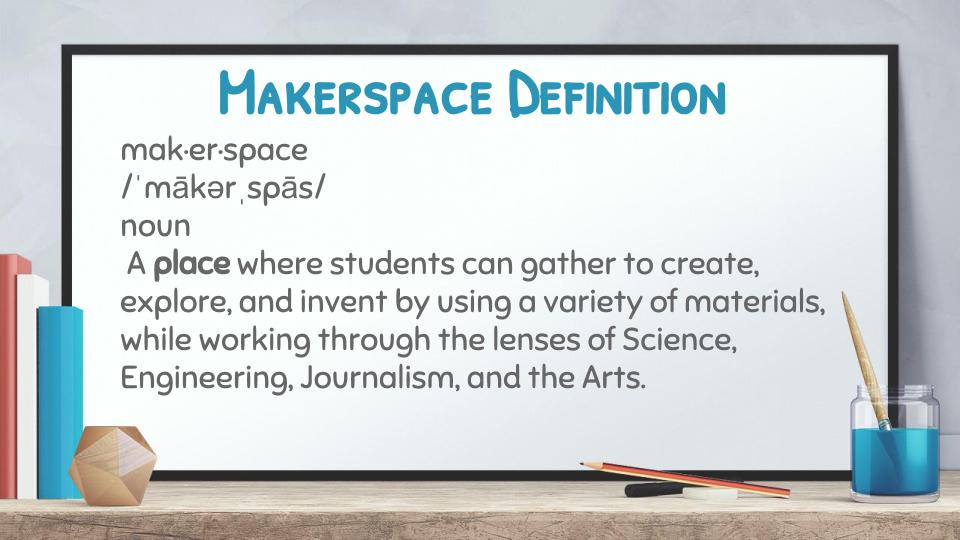
Design of Activities Can Increase STEAM Literacy
Activities can be designed purposefully via project based learning using challenge cards. This has been the focus of my recent research attempts, idea used in my dissertation study, and professional development over the last two years. After students are exposed to content, students can identify main ideas and concepts and fill out a KWHL chart. Afterwards, students participate in a makerspace challenge card activity taking on one of four career roles: (journalist, artist, engineer, or scientist). This encourages students to take on a STEAM career role to solve a problem. Teachers can design 4 challenge cards or encourage students to create their own. To learn more about the process, check out how students in a school in north Texas have utilized this concept. After participating in the makerspace process, students share their products with a wider community. Students then reflect via writing on their design process.
Teachers Need Hands-On Professional Development
In order to understand how to best design makerspace enrichment activities, teachers need to participate as a maker in a real makerspace. It is important to cultivate strong cohort teams in schools so that makerspace can truly enrich the classroom. Librarians serve as a wonderful resource and can be leveraged to facilitate activities. However, they cannot be the only makers on a campus or in a school program. Providing a strong community connection requires consistent mentoring and professional development.
To learn more, please feel free to connect with me. I offer services and professional development to schools, museums, and organizations centering on makerspace and STEAM strategic planning and training.
 Dr. Jennifer Miller-Ray
Leave a comment