Many people connect the makerspace movement to STEM (science, technology, engineering, and mathematics) activities through a project-based learning approach. As many are aware, the makerspace movement, founded by Dr. Seymor Papert’s (1991) theory of constructionism, is not a new learning theory or approach. Many schools and programs fail to really embrace the full power of Dr. Papert’s learning theory, which centers around social and intellectual practices to include the skill sets of problem solving, engagement, sharing expertise, and literacy (Tucker‐Raymond, Gravel, Wagh, Wilson, Manderino, & Castek, 2016).
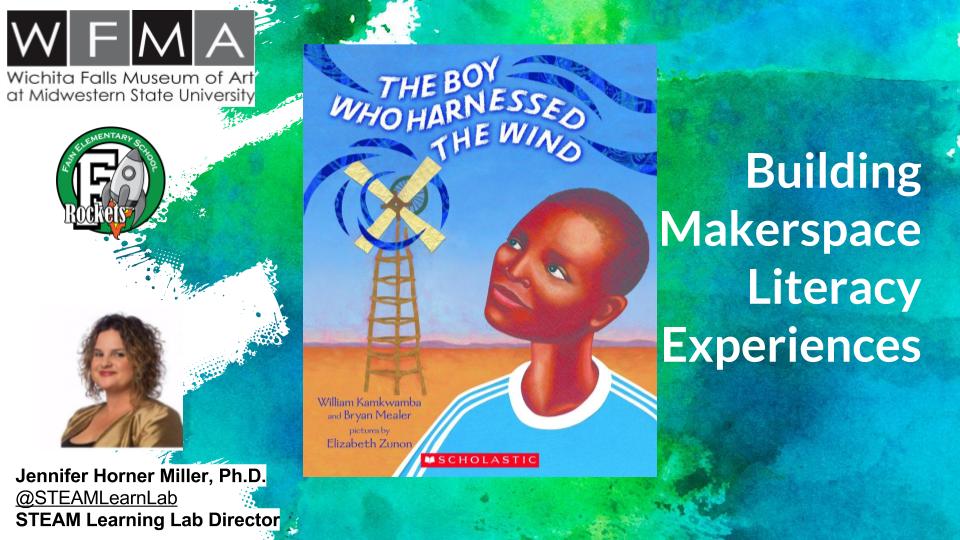
A recent example of this in practice was provided to elementary teachers during a workshop in north Texas recently. Teachers read the book, The Boy Who Harnessed the Wind. This book was selected as there is both a chapter version and young readers edition of the true story. Also, William’s story connects to so many STEM principles that we often see in a makerspace. After reading the story, teachers identified main ideas and concepts, inferences were made, and filled out an upgraded KWL 21st Century Style chart that I have found to be very helpful from Silvia Tolisano (2015). Afterwards, teachers made an artifact serving 1 of four career STEAM roles using the following challenge cards. Afterwards, teachers would reflect via writing. A link to the presentation and challenge card concept can be located below.
The following week we implemented this strategy in a Navajo school in northern Arizona. Students were very eager to learn about topics presented and built windmill prototypes and took on a makerspace project using the challenge card concept. Cards were adapted to bring in diversity topics of the Elements, to honor Navajo beliefs and culture. Navajo students will share their project soon with a larger community.
Papert, S., & Harel, I. (1991). Situating constructionism. Constructionism, 36(2), 1-11.
Tucker‐Raymond, E., Gravel, B. E., Wagh, A., Wilson, N., Manderino, M., & Castek, J. (2016). Making It Social: Considering the Purpose of Literacy to Support Participation in Making and Engineering. Journal of Adolescent & Adult Literacy, 60(2), 207-211.
 Dr. Jennifer Miller-Ray
Leave a comment