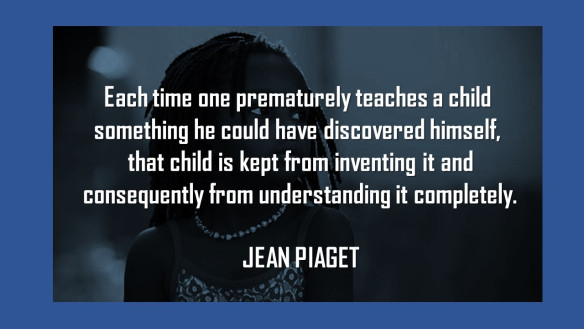
Personal learning theories on how children and adults best learn are often deeply rooted in past experiences, knowledge, and personal convictions (Ackermann, 2001). We had the unique opportunity to actually hear our great scholar’s explain questions of why and how to address learning as a science. Good (2011) was correct to point out the importance of teachers understanding the cognitive science and theories behind the learning process. This is essential toward improving the instructional design that Skinner speaks of in the video. Learning theories related to how children learn have existed since ancient times. Traditional behavioral learning theories stress the importance of the instructor. Knowledge is transmitted from the mind of the teacher, through lectures and words, imprinted to the student. Learning in a behaviorist’s perspective is a passive experience centered on memorization. Active learning theories evolved from traditional approaches. Piaget’s “Constructivism” continues to have far reaching implications to many modern theories. Constructivism centers on the thought that “knowledge is constructed within the learner’s mind on the basis of existing knowledge and new experiences” (Mavridis, Al Rashdi, Al Ketbi, Al Ketbi, & Marar, 2009). It was wonderful to view Piaget explain his own theories in the video Piaget on Piaget.
What do I believe about the science of learning?
Cognitive development and deep understanding are the foci of constructivism rather than emphasizing behaviors and skills (Fosnot & Perry, 1996). Social Constructivism, an extension of Piaget’s learning theory, stresses that learning is a meaningful and collaborative process employing a variety of perspectives (Smith & Ragan, 2005). Papert’s “Constructionism is a learning theory that adopts constructivist views, but also holds that learning happens most effectively when people are active in making objects to share in the real world” (Mavridis et al., 2009). Constructionism is a learning theory that considers the design as part of the building process. Constructionism allows learners to “dive into unknown situations,” introducing new perspectives (Ackerman, 2001). Constructionism principles outlined by Burbaite, Stuikys, and Damasevicius (2013) provide a framework to approaching e-learning environments.Prior knowledge impacts learning and knowledge is constructed, connecting to constructivist learning theory.Learning and knowledge occurs through the design of meaningful and authentic projects, creating an internal desire to learn.Learning is a process centering on integration of concepts from different realms of knowledge.Building and manipulating objects engage learners to connect and explore the world.Reflection on a learner’s form of understanding is a key component to learning. The above principals center on Papert’s ideas that “learning by making” is effective, allowing learners to construct, or elaborate, thereby providing richness and deeper learning experiences (Papert & Harel, 1991).Constructionist environments support “active learning” approaches in which learners are engaged in building their own public objects or artifacts. Active learning emphasizes cognitive processes occurring during the actual construction of the object. The public nature of the final object or artifact is also understood to be important (Beynon & Roe, 2004). The “maker movement emphasizes learning through direct experiences, hands-on projects, inventions, and is based on a constructionist learning theory even if members and advocates of the movement are unaware of the theory” (Stager, 2013). Papert (2000) advocates that Piaget’s belief of all learning takes place in discovery is accurate. However, Papert extends this idea to suggest that setting learners “to the task of re-empowering the ideas of being learned is also a step toward re-empowering the idea of learning by discovery” (p. 723). Papert (1999) underscores the importance of Piaget’s theory of constructivism and the nature of knowledge.How does this theory assist with understanding toward reading and cognitive processing?To be honest this is the area of improvement that I am working on. I have a strong cognitive science background, but Vaden (2013) presents us with a strong argument as to why teachers need to understand “neurological functioning of struggling readers” (p. 174) Brain science is fascinating and knowing how to address cognitive and behavioral skills during instruction can prove to be invaluable to any educator. For instance, strategies associated with word recognition should center around linking symbols with sounds, as research has linked “fluency to associating symbols with sounds” (Vaden, 20130, p. 181). It is exciting to learn that exposure to quality instructional design can profoundly increase reading comprehension.
How does this theory assist with understanding toward reading and cognitive processing?To be honest this is the area of improvement that I am working on. I have a strong cognitive science background, but Vaden (2013) presents us with a strong argument as to why teachers need to understand “neurological functioning of struggling readers” (p. 174) Brain science is fascinating and knowing how to address cognitive and behavioral skills during instruction can prove to be invaluable to any educator. For instance, strategies associated with word recognition should center around linking symbols with sounds, as research has linked “fluency to associating symbols with sounds” (Vaden, 20130, p. 181). It is exciting to learn that exposure to quality instructional design can profoundly increase reading comprehension. How can we provide this type of quality instructional experience? I believe we need to improve teaching education programs that address learning as a science, require quality professional development programs, and improve our instructional approaches to target issues and personalize intervention.
Ackermann, E. (2001). Piaget’s constructivism, Papert’s constructionism: What’s the difference. Future of learning group publication, 5(3), 438.
Beynon, M., & Roe, C. (2004). Computer support for constructionism in context. IEEE International Conference on Advanced Learning Technologies, 2004.
Burbaite, R., Stuikys, V., & Damasevicius, R. (2013, July). Educational robots as collaborative learning objects for teaching Computer Science. In System Science and Engineering (ICSSE), 2013 International Conference on (pp. 211-216). IEEE.
Edley, N. (2001). Unravelling Social Constructionism. Theory & Psychology, 11(3), 433–441.
Fosnot, C. T., & Perry, R. S. (1996). Constructivism: A psychological theory of learning. Constructivism: Theory, perspectives, and practice, 8-33.
Good, K. (2013). Intersections of educational psychology and the teaching of reading: connections in the classroom. In J.B. Cobb, & M. K. Kallus (Eds.), Historical, Theoretical, and Sociological Foundations of Reading in the United States (pp. 13-66). Boston, MA: Pearson.
Mavridis, N., Al Rashdi, A., Al Ketbi, M., Al Ketbi, S., & Marar, A. (2009, December). Exploring behaviors & collaborative mapping through Mindstorms robots: A case study in applied social constructionism at senior-project level. In Innovations in Information Technology, 2009. IIT’09. International Conference on (pp. 284-288). IEEE.
Papert, S. (1999). Papert on piaget. Número especial “The Century’s Greatest Minds,” Time, 29, 105.
Papert, S. (2000). What’s the big idea? Toward a pedagogy of idea power. IBM Systems Journal, 39(3.4), 720–729.
Smith, P. L., & Ragan, T. J. (2005). Foundations of Instructional Design. In, Instructional Design.
Stager, G. S. (2013). Papert’s Prison Fab Lab : Implications for the maker movement and education design, 487–490.
Vanden, S. R. (2013) The brain and reading. In J.B. Cobb, & M. K. Kallus (Eds.), Historical, Theoretical, and Sociological Foundations of Reading in the United States (pp. 13-66). Boston, MA: Pearson.
Cobb and Whitney’s research (2011) stressed that “contingent rewards initially undermine intrinsic motivation”, while non-contingent rewards may prompt readers to select easy reads (p. 90). My son, Nolan, is an avid fiction reader. He was failing his 7th grade reading class last six weeks because he did not want to read a nonfiction book. My oldest son, Ezekiel a 9th grader, is in all AP courses. He does not enjoy reading anymore but would always win the AR award for his elementary school. Both of my sons, the creative reader, and the engineer mind, have been failed by the AR system. Luckily, my youngest son loves to read, despite not enjoying the feeling of failure because he is not interested in the books he must read for the AR system. The oldest son was failed because he no longer reads at all unless it is an assignment.
Apparently, we are not alone. Many feel that reward systems are failing our students. Issues include lack of constructive and meaningful feedback, the selection of AR books, a focus on quizzes and not meaningful discussions about readings. I found a few blogs that really highlight the issues facing students who are being failed by the AR system to include http://blog.penningtonpublishing.com/reading/the-18-reasons-not-to-use-accelerated-reader/.
Are grades really a reward? I don’t see grades as reward, but grades are a measurement. Grades do not motivate all learners. Unless students are intrinsically motivated, they don’t really care about the grade. Also, what are we measuring?
Engagement and motivation is key. Assessment as a measurement tool helps us redirect instruction to engage students. AR in my option does not accomplish this for my son. What motivates kids? Sometimes competition works. Other students may not be competitive or care about measuring higher compared to peers.
Cobb, J. and Whitney, P. (2011) Who is the reader? cognitive, linguistic, and affective factors impacting readers. In J.B. Cobb, & M. K. Kallus (Eds.), Historical, Theoretical, and Sociological Foundations of Reading in the United States (pp. 13-66). Boston, MA: Pearson.
How did I learn to read? This is a good question to consider when thinking about the process of reading. Teresa Horner, a middle school librarian aide, taught me how to read at a very early age. Mrs. Horner is also my mother and avid reader, which enriched my opportunities toward becoming a successful reader. My mother took a big interest and engaged me every day with rhyming and song. Before I could read, I remember memorizing Baring-Goud & Baring-Gould’s Mother Goose (1967) nursery songs that we would sing together. Later we graduated to Dr. Seuss’s children books and rhymes. I learned to listen while other read to me and to interact with the reader via song. The public library always offered a summer reading program and my mother would escort all four of her children to the program each summer. As a kindergartner, we were able to have our parents read to us to sign off on our program. Participants were rewarded in some way, but I do not remember what the reward was. We were encouraged to read 10 books each summer, attend a weekly meeting, and participated in a party afterwards. As an early reader, we participated in literacy circles, met colorful authors and guest readers, and created artistic representations of the books we read during public library programs. I began to learn to read early in life, 4 to 5 years of age, with learning the alphabet. As the textbook mentions, pictures and song influenced both my ability to engage and comprehend readings. My first grade teacher, Mrs. Fortune, provided us with books that we would take home to read. They were very simple and required parent involvement. As we progressed to second, third, fourth, and fifth grade, I remember my mother encouraging us to read more. As a family, we would read chapter books to include the Boxcar Boys, Nancy Drew Mystery Stories, and Little House on the Prairie. Again, she took me to the public library each week and we would check out books together as a family. I don’t remember my school librarian at all and don’t remember the school library being a fun learning environment. The public library was always of interest to me.
Baring-Gould, W. S., & Baring-Gould, C. (1967). The annotated Mother Goose: nursery rhymes old and new. New American Library.
Cobb, J. B., & Kallus, M. K. (2011). Historical, theoretical, and sociological foundations of reading in the united states. Boston, MD: Pearson Education Inc.
What is the difference between the look-say and the phonics approaches to teaching reading. What did the first grade studies tell us about these methods?
Mitford Mathews’s reading method words-to-reading, or look-say, introduces a large amount of vocabulary words as sight words to the reader. For instance, the teacher would introduce a letter and then provide a list of words and ask the learner to “note or listen for similarity between sounds of letters in each word” (Cobb & Kallus, 2011, p. 16). Matthews look-say method was widely accepted for most of the 20th century. After sight words are introduced, the student would be introduced to analytic phonics, or generalizations, which were applied to a particular sound correspondence. The idea that readers would respond more rapidly as they recognize whole words, or look-say, rather than a letter-sound relationship.
Phonics approaches to reading teach the student the sound to say each time they observe a symbol, or a sound to a letter approach. The learner is then motivated to decode words that they encounter. Prior to the first grade studies, reading began in first grade. Sight words, or the look-say method, was used, and analytic phonics introduced. Vocabulary was tightly controlled in grades 1-3, and children worked in small groups. However, the first grade studies highlighted a need to revamp the entire education system, as Chall found that an early code emphasis would be beneficial toward word recognition at an earlier age. As a result, a greater emphasis and intensity was placed on phonics at an earlier age. A change in curriculum was implemented. No longer did schools employ the Dick and Jane approach in first grade. Students were introduced to a wider library collection, to include a focus on children’s literature, with little vocabulary restriction.
Look at the examples of texts in the table on p. 29. What was the underlying assumption about how reading should be taught for each type of text?
Each example provides an opportunity for educators to explore how to best help a student learn to read, not to to focus on teaching a student to read, an idea expanded upon by Frank Smith (1971). Smith valued the importance of literacy experiences on cognition and stressed the importance of value texts for early readers. He also suggested that a mistake was an opportunity to explore the inner workings of the child’s mind, with a focus on cognitive processes and strategies. Each example provides a strategy using value text to assist the teacher. Example one employs patterns, language rhyming, so that the early reader can predict what is coming next and then understands the meaning. It reminds me of the same principles and strategies that we currently utilize when using a program like flocabulary. It is a great way to introduce vocabulary to students. Students are engaged and can predict what is coming next using language rhyming. The other two examples rely on high frequency words and are the best approach toward engaging beginning readers. Example two utilize rhythm patterns, repetition, and rendition so that the learner can interpreting and interacting with text. Decoding text, the third example, utilize phonics and is not the preferred choice. A beginner can learn one or two words from repetition but do they really know what the words mean? Example one incorporates an improved approach because it encompasses a language rhyme and patterns to help the emerging reader make sense of the words read. It is interesting to me that Smith (1971) warns of the dangers of relying heavily of visuals when so much screen time is placed in front of our students in K-12 environments.
How does the notion of integrated curriculum relate to the ideas proposed by sociolinguistics?
Both rely on the premise that perspectives, rooted in cultural heritages, should be valued and contribute toward improving knowledge acquisition through a global lens. Both examples create a more meaningful approach, as differences are valued and not seen as a shortcoming. For example, integrating curriculum can break down barriers between core content areas so that diverse learners can make sense of how each content area contributes to the “real world”. Sociolinguistics adopts this same concept, as the idea values dialects. Integrating dialects exposes learners to new cultures and communities of thought through perspectives. Learners can learn dialects from each other, and as a result, learners develop a better understand of how language differences can contribute toward a better understanding of community. Both approaches create a more globally competent student. In addition, both integrated curriculum and sociolinguistics adopt the idea that reading and language is best understood when put to use for another purpose, learning activity, or event.
Cobb, J. B., & Kallus, M. K. (2011). Historical, theoretical, and sociological foundations of reading in the united states. Boston, MD: Pearson Education Inc.
Smith, F. (1971). Understanding Reading: A Linguistic Analysis of Reading and Learning to Read. New York: Holt, Rinehart and Winston.

 Dr. Jennifer Miller-Ray