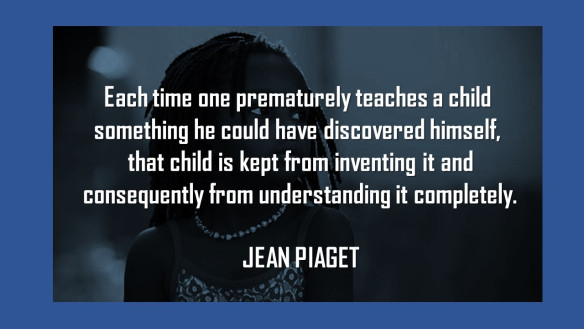
Personal learning theories on how children and adults best learn are often deeply rooted in past experiences, knowledge, and personal convictions (Ackermann, 2001). We had the unique opportunity to actually hear our great scholar’s explain questions of why and how to address learning as a science. Good (2011) was correct to point out the importance of teachers understanding the cognitive science and theories behind the learning process. This is essential toward improving the instructional design that Skinner speaks of in the video. Learning theories related to how children learn have existed since ancient times. Traditional behavioral learning theories stress the importance of the instructor. Knowledge is transmitted from the mind of the teacher, through lectures and words, imprinted to the student. Learning in a behaviorist’s perspective is a passive experience centered on memorization. Active learning theories evolved from traditional approaches. Piaget’s “Constructivism” continues to have far reaching implications to many modern theories. Constructivism centers on the thought that “knowledge is constructed within the learner’s mind on the basis of existing knowledge and new experiences” (Mavridis, Al Rashdi, Al Ketbi, Al Ketbi, & Marar, 2009). It was wonderful to view Piaget explain his own theories in the video Piaget on Piaget.
What do I believe about the science of learning?
Cognitive development and deep understanding are the foci of constructivism rather than emphasizing behaviors and skills (Fosnot & Perry, 1996). Social Constructivism, an extension of Piaget’s learning theory, stresses that learning is a meaningful and collaborative process employing a variety of perspectives (Smith & Ragan, 2005). Papert’s “Constructionism is a learning theory that adopts constructivist views, but also holds that learning happens most effectively when people are active in making objects to share in the real world” (Mavridis et al., 2009). Constructionism is a learning theory that considers the design as part of the building process. Constructionism allows learners to “dive into unknown situations,” introducing new perspectives (Ackerman, 2001). Constructionism principles outlined by Burbaite, Stuikys, and Damasevicius (2013) provide a framework to approaching e-learning environments.Prior knowledge impacts learning and knowledge is constructed, connecting to constructivist learning theory.Learning and knowledge occurs through the design of meaningful and authentic projects, creating an internal desire to learn.Learning is a process centering on integration of concepts from different realms of knowledge.Building and manipulating objects engage learners to connect and explore the world.Reflection on a learner’s form of understanding is a key component to learning. The above principals center on Papert’s ideas that “learning by making” is effective, allowing learners to construct, or elaborate, thereby providing richness and deeper learning experiences (Papert & Harel, 1991).Constructionist environments support “active learning” approaches in which learners are engaged in building their own public objects or artifacts. Active learning emphasizes cognitive processes occurring during the actual construction of the object. The public nature of the final object or artifact is also understood to be important (Beynon & Roe, 2004). The “maker movement emphasizes learning through direct experiences, hands-on projects, inventions, and is based on a constructionist learning theory even if members and advocates of the movement are unaware of the theory” (Stager, 2013). Papert (2000) advocates that Piaget’s belief of all learning takes place in discovery is accurate. However, Papert extends this idea to suggest that setting learners “to the task of re-empowering the ideas of being learned is also a step toward re-empowering the idea of learning by discovery” (p. 723). Papert (1999) underscores the importance of Piaget’s theory of constructivism and the nature of knowledge.How does this theory assist with understanding toward reading and cognitive processing?To be honest this is the area of improvement that I am working on. I have a strong cognitive science background, but Vaden (2013) presents us with a strong argument as to why teachers need to understand “neurological functioning of struggling readers” (p. 174) Brain science is fascinating and knowing how to address cognitive and behavioral skills during instruction can prove to be invaluable to any educator. For instance, strategies associated with word recognition should center around linking symbols with sounds, as research has linked “fluency to associating symbols with sounds” (Vaden, 20130, p. 181). It is exciting to learn that exposure to quality instructional design can profoundly increase reading comprehension.
How does this theory assist with understanding toward reading and cognitive processing?To be honest this is the area of improvement that I am working on. I have a strong cognitive science background, but Vaden (2013) presents us with a strong argument as to why teachers need to understand “neurological functioning of struggling readers” (p. 174) Brain science is fascinating and knowing how to address cognitive and behavioral skills during instruction can prove to be invaluable to any educator. For instance, strategies associated with word recognition should center around linking symbols with sounds, as research has linked “fluency to associating symbols with sounds” (Vaden, 20130, p. 181). It is exciting to learn that exposure to quality instructional design can profoundly increase reading comprehension. How can we provide this type of quality instructional experience? I believe we need to improve teaching education programs that address learning as a science, require quality professional development programs, and improve our instructional approaches to target issues and personalize intervention.
Ackermann, E. (2001). Piaget’s constructivism, Papert’s constructionism: What’s the difference. Future of learning group publication, 5(3), 438.
Beynon, M., & Roe, C. (2004). Computer support for constructionism in context. IEEE International Conference on Advanced Learning Technologies, 2004.
Burbaite, R., Stuikys, V., & Damasevicius, R. (2013, July). Educational robots as collaborative learning objects for teaching Computer Science. In System Science and Engineering (ICSSE), 2013 International Conference on (pp. 211-216). IEEE.
Edley, N. (2001). Unravelling Social Constructionism. Theory & Psychology, 11(3), 433–441.
Fosnot, C. T., & Perry, R. S. (1996). Constructivism: A psychological theory of learning. Constructivism: Theory, perspectives, and practice, 8-33.
Good, K. (2013). Intersections of educational psychology and the teaching of reading: connections in the classroom. In J.B. Cobb, & M. K. Kallus (Eds.), Historical, Theoretical, and Sociological Foundations of Reading in the United States (pp. 13-66). Boston, MA: Pearson.
Mavridis, N., Al Rashdi, A., Al Ketbi, M., Al Ketbi, S., & Marar, A. (2009, December). Exploring behaviors & collaborative mapping through Mindstorms robots: A case study in applied social constructionism at senior-project level. In Innovations in Information Technology, 2009. IIT’09. International Conference on (pp. 284-288). IEEE.
Papert, S. (1999). Papert on piaget. Número especial “The Century’s Greatest Minds,” Time, 29, 105.
Papert, S. (2000). What’s the big idea? Toward a pedagogy of idea power. IBM Systems Journal, 39(3.4), 720–729.
Smith, P. L., & Ragan, T. J. (2005). Foundations of Instructional Design. In, Instructional Design.
Stager, G. S. (2013). Papert’s Prison Fab Lab : Implications for the maker movement and education design, 487–490.
Vanden, S. R. (2013) The brain and reading. In J.B. Cobb, & M. K. Kallus (Eds.), Historical, Theoretical, and Sociological Foundations of Reading in the United States (pp. 13-66). Boston, MA: Pearson.
 Dr. Jennifer Miller-Ray
Leave a comment