Category: Instruction

  • Leveraging Multisensory Approaches When Teaching Phonological Awareness Tasks

    Birsh (2018) defines phonemic awareness using The Partnership of Reading’s definition “as the ability to notice think about and work with the individual sounds in words (2003, p. 2). Phonemic awareness is an essential toward learning how to read as it helps children connect the spoken word to written language Birsh (2018). How does multisensory approaches facilitate phonemic awareness in children? Farrell & White (2018) suggest that “multisensory strategies guide students to in simultaneously linking input from eye, ear, voice, and hand to enhance learning during the carefully sequenced teaching of all systems of language” (p. 47). Phonological stimulation must begin as early as possible. Sensory stimulation through a multisensory approach of increased “auditory modeling and feedback, tactile stimulation of the articulators, visual feedback through clinician modeling, picture models of articulatory placement and the use of mirrors build cognitive connections to phonological awareness”  Pierettie, Kaul, Zarchy, & O’Hanion (2015) Adoption of multisensory approaches assists teachers in facilitating multiple avenues toward improved cognition and fully involve students to an improved learning experience.

    What does a multisensory approach to teach phonemic awareness look like in an early learning environment? Segmenting is a phonemic awareness task introduced later in the hierarchy of teaching phonemic awareness. Children learn segmenting of phonemes as they learn to identify and sort objects beginning with the same sound and later progress to focus on words with the same ending sound. An auditory task that teachers could incorporate besides saying a new vocabulary word through segmenting and blending might be to give directions using in a robot voice. Students could also make a bead slide, in which children use beads to move on a string to break the word into individual sounds as the teacher and children say the sound aloud. Teachers can use shoelaces and beads to complete this activity. This activity leverages both auditory and kinesthetic activities to assist with teaching segmentation. Games are a fun approach toward teaching the segmenting phonemic awareness task and can incorporate auditory, kinesthetic, and visual cues. For example, using “Elkonin boxes to tap a finger or place a chip in a designated box to match the number of syllables to a word” (Paulson, 2018). After a teacher models this activity, students can take turns saying and moving a chip or token. Over time the visual cue or box can eventually be eliminated from this activity.

    Strengthening cognition through multisensory approaches during early literacy will promote successful decoding when reading, which will allow for additional time and energy to be focused on reading comprehension (Pierettie, Kaul, Zarchy, & O’Hanion, 2015). Understanding how to leverage multisensory approaches to strengthen phonological awareness in early childhood programs can lead to an improved early intervention program. An emphasis on multisensory approaches within new teacher training could assist in building a stronger phonemic awareness early literacy program.

    Pieretti, R. A., Kaul, S. D., Zarchy, R. M., & O’Hanlon, L. M. (2015). Using a multimodal approach to facilitate articulation, phonemic awareness, and literacy in young children. Communication Disorders Quarterly, 36(3), 131-141.

    Birsh, J. R. & Carreker, S. Multisensory teaching of basic language skills (4th Ed). Baltimore, MD: Paul H. Brookes Publishing Co.

    Farrell, M., White, N. C. (2018). Structured literacy instruction. In Birsh, J. R. & Carreker, S. Multisensory teaching of basic language skills (4th Ed). Baltimore, MD: Paul H. Brookes Publishing Co.
    Paulson, L. H. (2018). Teaching phonemic awareness. In Birsh, J. R. & Carreker, S. Multisensory teaching of basic language skills (4th Ed). Baltimore, MD: Paul H. Brookes Publishing Co.


  • Why We Should Begin to Address Digital Disconnect for ELL Learners

    Gunderson (2013) highlights how technologies can create new opportunities and improve ELL literacies as long as barriers are addressed to improve teachers’ self-efficacy with a focus on  technology skills and confidence in professional development, funding to address equity issues, and curriculum in place to address “Digital Disconnect” in schools. Many opportunities exist to improve L2 academic performance. Park & Warschuer (2016) provide compelling evidence to suggest that activating background knowledge through integration of technology using hyperlinked media can begin to address gaps and provide valuable resources. The Multiliteracy Project is one project that caught my attention as students are able to contribute to a meaningful project in their first language and utilizes many diverse literacies that connect to my research interest. The Multiliteracy Project website, http://multiliteracies.ca/index.php/stat/register, connects students to projects around the world using many forms of literacies that promote social responsibility. Gunderson (2013) shares how hyperlinks in one project. Students produce Blue Sea Creatures hyperlinks. This could be of interest to ELL students, as they are curating content and researching to locate valid information and media, to share with others. We are working on Texas land forms and I could see how ELL learners could use this idea using hyperlinks to create their own website. We could utilize both Spanish and English in hyperlinks to provide additional information to users in Google Sites.

    Park & Warschaurer (2016)  provide strong evidence as to how multi-modal vocabulary support can assist ELL learners. Encouraging ELL learners to “express themselves in multiple ways” can provide significant gains in academic vocabulary acquisition (Park & Warschurer, 2016, p. 288). Gunderson (2013) provides many resources and ideas on how to leverage visual imagery to improve comprehensible input. Diccts.info, https://www.dicts.info/, offers users easy search features and includes a universal dictionary, basic vocabulary, picture dictionary, English dictionary, Phrases, Bilingual dictionaries, Flashcards, Vocabulary trainer, English thesaurus, and Examples of use feature. I began searching the words that are using and found that the picture dictionary is limited. For instance, the word mountain and range are both not included in search results.  Range is listed in results but does not populate a search result when selected. While this does serve as a good beginning resource, it highlights the issues facing teachers. I reviewed the PDictionary, http://pdictionary.com, and had a similar experience. I did locate cactus, which is a vocabulary word in this resource. These resources could be useful in teaching ELL students how to look up information, which Gunderson (2013) strongly encourages as a component of information literacy.

    As a strong advocate of information literacy, I appreciate Gunderson’s (2013) approach toward teaching critical literacy online. To me this is the largest issue and serves to begin to finally address the Digital Disconnect Gunderson (2013) discusses. So many classrooms and curriculum teach technology as a skill set but this approach sometimes misses the mark. Digital literacy is more than a skill set, it is a critical thinking approach to validating information prior to possibility creating meaning and products. Therefore, I agree that we must teach online critical literacy skills in all courses and begin to address how to search information, how to evaluate media, and how to read online. I really Gunderson’s (2011) practices of “teaching reading online to identify important questions, to locate information, to critically evaluate information, to synthesize information, and to communicate information” (p. 247). In essence, all teachers should be required to address how to accomplish reading online through these five actions. I can suggest that we begin to do this for  makerspace projects. One part of the makerspace process is research and through the making of the product, he will be creating and communicating his process online. So, I have decided to add a digital layer on the process.  This will strengthen is use of vocabulary as ELL learners will select how the student communicates to share final productions online.

    pexels-photo-278312.jpeg


    Gunderson, L., D’Silva, R., & Odo, D. M. (2013). ESL (ELL) literacy instruction: A guidebook to theory and practice. Routledge.

    Park, Y. and Warschauer M. (2016) Reading instruction in a technological age.  In X. Chen, V. Dronjic, & R. Helms-Park, Reading in a second language: Cognitive and psycholinguistic issues (pp. 282-302). New York: Routledge.

  • Reward Systems May Not Motivate Learners

    Cobb and Whitney’s research (2011) stressed that “contingent rewards initially undermine intrinsic motivation”, while non-contingent rewards may prompt readers to select easy reads (p. 90). My son, Nolan, is an avid fiction reader. He was failing his 7th grade reading class last six weeks because he did not want to read a nonfiction book. My oldest  son, Ezekiel a 9th grader, is in all AP courses. He does not enjoy reading anymore but would always win the AR award for his elementary school. Both of my sons, the creative reader, and the engineer mind, have been failed by the AR system. Luckily, my youngest son loves to read, despite not enjoying the feeling of failure because he is not interested in the books he must read for the AR system. The oldest son was failed because he no longer reads at all unless it is an assignment.

    Apparently, we are not alone. Many feel that reward systems are failing our students. Issues include lack of constructive and meaningful feedback, the selection of AR books, a focus on quizzes and not meaningful discussions about readings. I found a few blogs that really highlight the issues facing students who are being failed by the AR system to include http://blog.penningtonpublishing.com/reading/the-18-reasons-not-to-use-accelerated-reader/.

    Are grades really a reward? I don’t see grades as reward, but grades are a measurement. Grades do not motivate all learners. Unless students are intrinsically motivated, they don’t really care about the grade. Also, what are we measuring?

    Engagement and motivation is key. Assessment as a measurement tool helps us redirect instruction to engage students. AR in my option does not accomplish this for my son. What motivates kids? Sometimes competition works. Other students may not be competitive or care about measuring higher compared to peers.

    Cobb, J. and Whitney, P. (2011) Who is the reader? cognitive, linguistic, and affective factors impacting readers.  In J.B. Cobb, & M. K. Kallus (Eds.), Historical, Theoretical, and Sociological Foundations of Reading in the United States (pp. 13-66). Boston, MA: Pearson.

  • Reflection on Reading in the 20th Century


    What is the difference between the look-say and the phonics approaches to teaching reading. What did the first grade studies tell us about these methods?

    Mitford Mathews’s reading method words-to-reading, or look-say, introduces a large amount of vocabulary words as sight words to the reader. For instance, the teacher would introduce a letter and then provide a list of words and ask the learner to “note or listen for similarity between sounds of letters in each word” (Cobb & Kallus, 2011, p. 16). Matthews look-say method was widely accepted for most of the 20th century. After sight words are introduced, the student would be introduced to analytic phonics, or generalizations, which were applied to a particular sound correspondence.  The idea that readers would respond more rapidly as they recognize whole words, or look-say, rather than a letter-sound relationship.

    Phonics approaches to reading teach the student the sound to say each time they observe a symbol, or a sound to a letter approach. The learner is then motivated to decode words that they encounter. Prior to the first grade studies, reading began in first grade. Sight words, or the look-say method, was used, and analytic phonics introduced. Vocabulary was tightly controlled in grades 1-3, and children worked in small groups. However, the first grade studies highlighted a need to revamp the entire education system, as Chall found that an early code emphasis would be beneficial toward word recognition at an earlier age. As a result, a greater emphasis and intensity was placed on phonics at an earlier age. A change in curriculum was implemented. No longer did schools employ the Dick and Jane approach in first grade. Students were introduced to a wider library collection, to include a focus on children’s literature, with little vocabulary restriction.

    Look at the examples of texts in the table on p. 29. What was the underlying assumption about how reading should be taught for each type of text?

    Each example provides an opportunity for educators to explore how to best help a student learn to read, not to to focus on teaching a student to read, an idea expanded upon by Frank Smith (1971). Smith valued the importance of literacy experiences on cognition and stressed the importance of value texts for early readers.  He also suggested that a mistake was an opportunity to explore the inner workings of the child’s mind, with a focus on cognitive processes and strategies. Each example provides a strategy using value text to assist the teacher. Example one employs patterns, language rhyming,  so that the early reader can predict what is coming next and then understands the meaning. It reminds me of the same principles and strategies that we currently utilize when using a program like flocabulary. It is a great way to introduce vocabulary to students. Students are engaged and can predict what is coming next using language rhyming. The other two examples rely on high frequency words and are the best approach toward engaging beginning readers. Example two utilize rhythm patterns, repetition, and rendition so that the learner can interpreting and interacting with text. Decoding text, the third example, utilize phonics and is not the preferred choice. A beginner can learn one or two words from repetition but do they really know what the words mean? Example one incorporates an improved approach because it encompasses a language rhyme and patterns to help the emerging reader make sense of the words read. It is interesting to me that Smith (1971) warns of the dangers of relying heavily of visuals when so much screen time is placed in front of our students in K-12 environments.

    How does the notion of integrated curriculum relate to the ideas proposed by sociolinguistics?

    Both rely on the premise that perspectives, rooted in cultural heritages, should be valued and contribute toward improving knowledge acquisition through a global lens. Both examples create a more meaningful approach, as differences are valued and not seen as a shortcoming. For example, integrating curriculum can break down barriers between core content areas so that diverse learners can make sense of how each content area contributes to the “real world”. Sociolinguistics adopts this same concept, as the idea values dialects. Integrating dialects exposes learners to new cultures and communities of thought through perspectives. Learners can learn dialects from each other, and as a result, learners develop a better understand of how language differences can contribute toward a better understanding of community. Both approaches create a more globally competent student. In addition, both integrated curriculum and sociolinguistics adopt the idea that reading and language is best understood when put to use for another purpose, learning activity, or event.

    Cobb, J. B., & Kallus, M. K. (2011). Historical, theoretical, and sociological foundations of reading in the united states. Boston, MD: Pearson Education Inc.

    Smith, F. (1971). Understanding Reading: A Linguistic Analysis of Reading and Learning to Read. New York: Holt, Rinehart and Winston.


  • Leading as a Literacy Principal

    As an educator, I have always been passionate about literacy and have continued to seek out new learning. My literacy thinking has been refined as I’ve read books by Regie Routman, Donalyn Miller, Boushey and Moser, Richard Allington, Fisher and Frey, and now Jennifer Allen. Becoming a Literacy Leader is a goldmine of a book […]

    via Leading as a Reading Principal — Reading By Example

  • Choose Your Own Adventure.. My Summer Professional Learning Reflections

    Choose Your Own Adventure.. My Summer Professional Learning Reflections

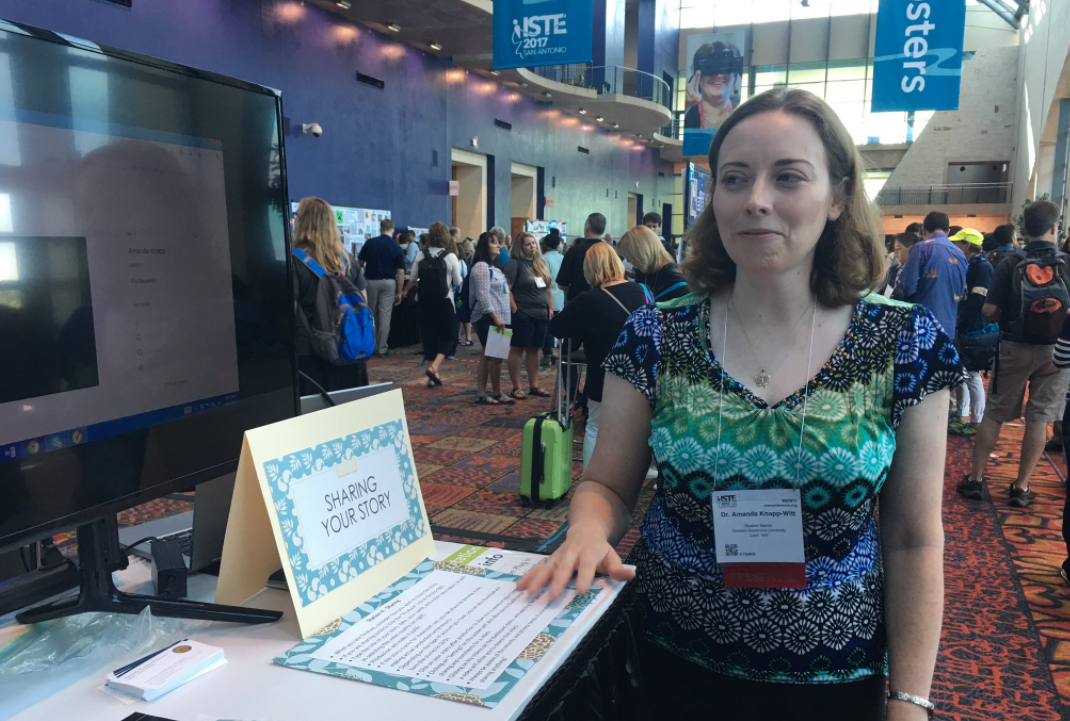
    Anyone involved in public education knows that summers are full of opportunities for educators to embrace professional learning.  Educators and leaders are surrounded with many avenues to model life-long learning. No longer do we have to wait for PD to come to us. This year I had the opportunity to connect and grow my PLN for an entire two months. For the first time in five years, I was not enrolled in graduate courses or completing a dissertation,  free to just learn about any topic of interest and connect. I attended multiple conferences to include Texas ASCD Ignite, ISTE, Denton’s TIA, and immersed myself with exploring content in multiple museums, even visiting the Library of Congress to research the upcoming solar eclipse. Certain themes emerged this summer during my adventure.

    Creativity Matters

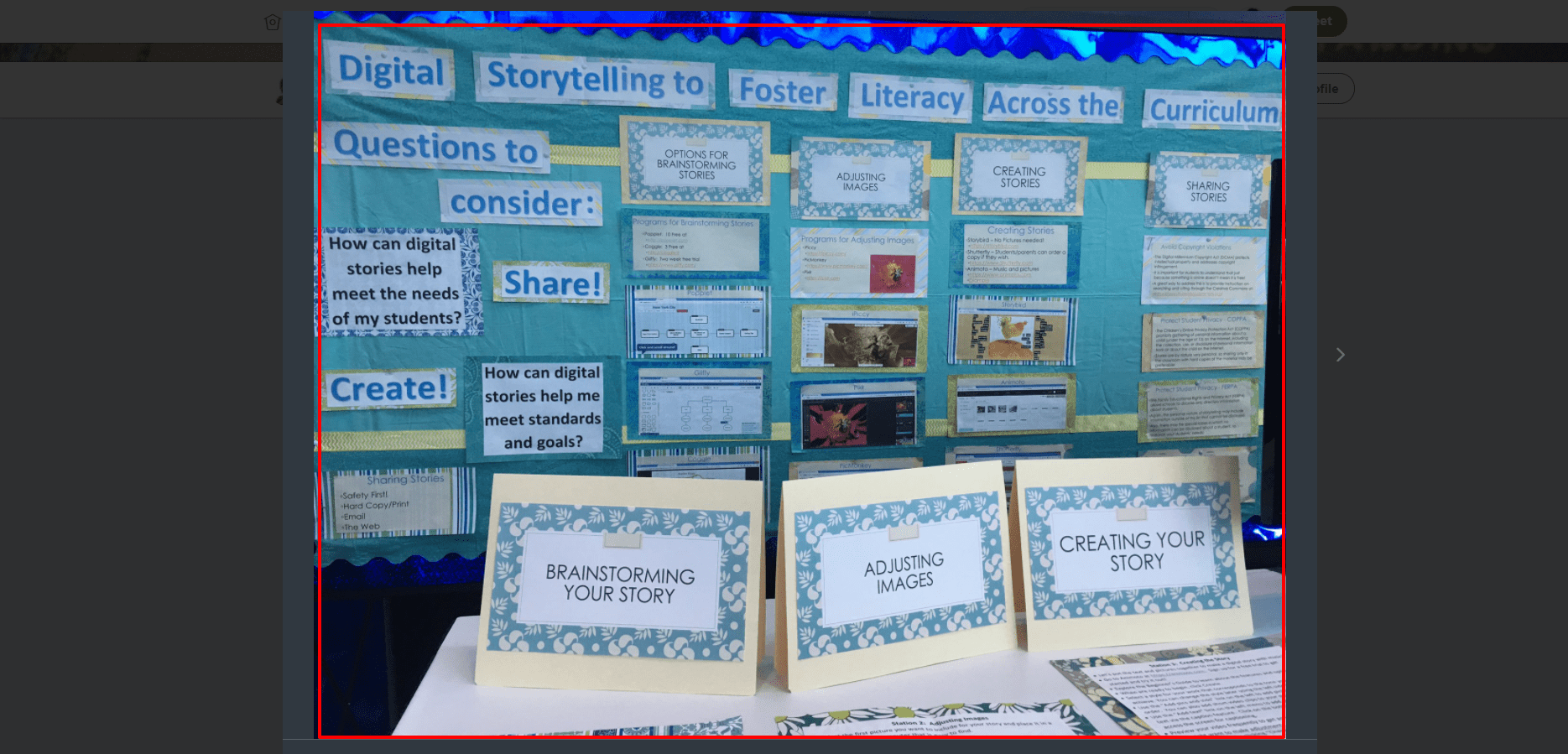
    With so many makerspace, STEM, and STEAM apps, and instructional approaches available to organizations and teachers, choices and program approaches can become overwhelming. It was exciting to see so many great project-based learning approaches centered around storytelling. Many schools are combining storytelling with gaming. For example, it was cool to see how students really engaged with Minecrafting a Colonial City. I liked the following process used toward incorporating digital storytelling with core curriculum.

    Dr Jennifer Miller steamlearnlab Twitter (2)

    Dr Jennifer Miller steamlearnlab Twitter (3)

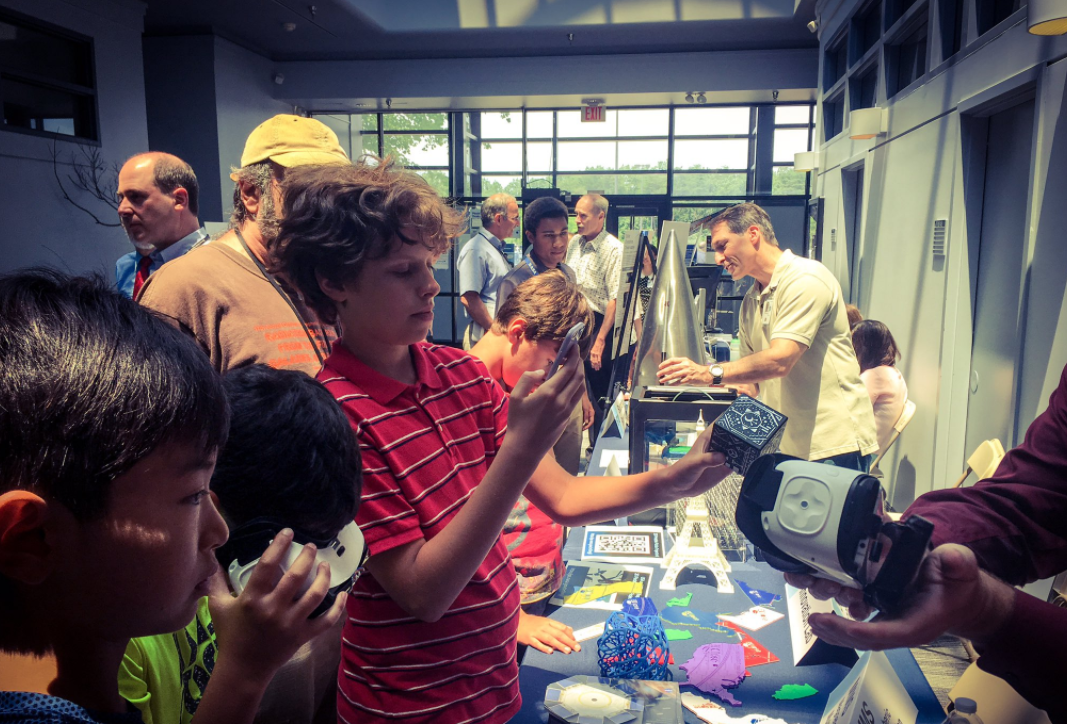
    Lewisville ISD has incorporated a mobile transportation lab, a collaborative unit, serving 70 libraries and STEAM labs. This provides an introduction to educators and students toward creative learning technology approaches. I visited NASA’s STEM Innovation Lab at Goddard Space Center and I was inspired by the many uses of the 3D printer. Learners of all ages were inspired to learn using 3D printed models, which encourages me to continue producing curriculum and 3D printing training programs.

    Dr Jennifer Miller steamlearnlab Twitter (4)

    Transparency Matters

    Eric Schlesinger always inspires. He recently provided a keynote at Denton TIA in which he reminded us that transparency really does matter. I have been a heavy user at times of social media, blogging, and at times have had to unplug. Often those whom are very plugged in are criticized for bragging. However, Eric reminds us that branding your story isn’t only ok, it is necessary toward being transparent and building trust. In fact, telling your story connects learning to stakeholders. He reminded us of the importance of being transparent and consistent with our posts. During the last two years, I had dropped my professional blog posts. After hearing him speak last week, I decided to pick up my blog and begin consistently posting once a week. Hopefully, this exercise will increase my ability to communicate digital learning and cognitive science approaches to all stakeholders. Change does not come from opinions. Change is brought about by the examples we set and our reactions toward others.

    Community Matters

    It is important to remember that the teacher makes the difference! It was very inspiring to see how teachers at WELD Re-4 School District deliver a creative conference in which students, business leaders, and educators provide professional learning sessions to the entire community. A result of this program included a new scholarship program,  innovations scholarships, which are provided toward students who demonstrate quality interactive student showcases.

    The final takeaway for this summer is that true learning is FUN! I am very grateful to have had this opportunity to learn and connect with so many around the world. This is going to be an amazing school year!


  • Exploring Advanced Instructional Design iCARE, Blooms, and Backwards Design Models

    Image
    Building Connections…

    iCARE Instructional Design Model

    Rhonda Ritter’s presentation on the iCARE instructional design model provides an excellent framework to utilize with secondary/post-secondary students.  The iCARE model, from my perspective,  builds strong connections to 21st century learning skill sets. iCARE consists of a simple and flexible design approach.  iCARE  (Introduction, Connect, Apply, Reflect, and Extend) provides students with  answers to why learning content is needed and how content extends to “real world” scenarios.  Students often need to extend reflections to a larger audience. Students who often lack motivation to earn or make the grade, and iCARE provides an external motivator that could push students towards lifelong learning.  Online learning environments offer a variety of collaborative platforms, and the iCARE model could easily provide learning communities an improved online environment to “showcase” and extended learning to a larger audience.

    Backwards Design

    Brenda Quintanilla provided a strong presentation on how the Backwards Design model improves instruction by aligning objectives to final outcomes.  Backward design suggests that learning design should should begin with  a final assessment in mind.  Backward design attempts to ensure that students meet the expected outcomes or course goals.   While I agree that aligning is very important, instructors must be cautioned to not “teach to the test.”  Drill and kill approaches often fail to inspire students to apply content to real world scenarios or approaches.  Goals are important, but assessment driven instruction can become repetitive.  Educators and instructors perhaps need training on best practices on using Backward Design approaches.  The following link can help improve Backward Design approaches.

    Blooms Taxonomy

    Christina Gilliam’s provided an informative review of how Blooms order of domain has shifted to include remembering, understanding, applying, analyzing, evaluating, and creating.   Gilliam’s presentation included key domain questions  and verbs to consider.

    Integration and community approaches using technology can potentially provide differentiated instruction efficiently.  Training and coaching on best Blooms practices using technology will continue to be a high need.  Instructional designers can assist teachers with how to apply advanced instructional models using learning technologies.

    Blooms Model applied to iPod/iPad Apps

    Nice Wiki on Advanced Instructional Design and Learning Technologies

    This image has been sourced from http://www.usi.edu/distance/bdt.htm.

    (more…)