Category: Learning

  • Reflective Teaching ~ Exploring My Makerspace Literacy Research Approaches and Classroom Practice

    Currently, I teach six graduate education courses at Sul Ross State University, which is a small rural university serving 898 graduate students and a little over 2,000 undergraduate students. The institution is a Hispanic serving institution, serving low income students (Jenkins, et al., 2017). I am working with many rural schools in the Big Bend area to include Presidio ISD. Presidio ISD is a STEM school, and serves a population of 1,350 students to include demographics of 96.6 % Hispanic students and 93.4% economically disadvantaged students (2015). Presdio ISD is located on the Rio Grande river, located on the Texas-Mexican border. In addition, I am working with Maathon ISD, which is a rural district serving over 70 students to include a demographic population of 67 % Hispanics and 87 % economically disadvantaged students (2015). I am also working with several districts in the Trans-Pecos area.

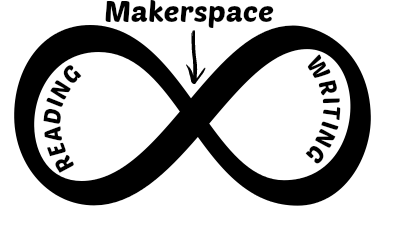
    My learning goals this academic year is to grow as an educator and continue improving my Ph.D. research initiatives at the University of North Texas investigating makerspace literacy environments that centers around a project-based learning 4 career STEAM model targeting elementary and middle school programs.  My knowledge regarding the reading process has definitely changed and improved this semester. Perhaps the most significant change includes reevaluating my approach to really center on balanced literacy approaches that really think about transactional theory in action during professional development and instructional design approaches. Transactional theory centers on “how readers respond to the books that engage them and how these experiences can be enacted in classrooms” (Galda, 2013, p. 6). Transactional theory is rooted in Vygotsky’s social constructivism and principles of language and cognition, “which centers of teaching reading and writing highlighting creation of environments and activities in which students are motivated and encouraged to draw on their own resources to make live meanings” (Rosenblatt, 2013, p. 148).
    infinity_1_orig

    What will I eliminate in the future? I will eliminate some of the STEM quantitative measures I have used in the past. These instruments were only used to show interest and attitude toward STEM and never measured the impact on the overall impact of literacy. Previously, I would give this instrument before and after a STEM makerspace camp or at the beginning of a semester and at the end of a semester to gauge interest. I utilized the makerspace project-based learning model and only measured the impact of interest. The model did incorporate reading prior to the makerspace PBL and a written reflection after the experience. The pre and posttest utilized in two published studies found statistically significant findings but failed to measure the impact on reading and literacy.  The learner would take the STEM Semantic pre-test, read text from their content area, participate in a KWLH 21st century learning activity, participate in a makerspace project-based learning activity using challenge cards mapped to curriculum, and reflect via writing about the experience. At the end, learners would take another post-test, the STEM Semantic survey. I have not really considered the empirical design approaches to include journaling during the entire makerspace process and/or video recordings to include in portfolios in research approaches. In the past, I have used only quantitative measures to gauge student or teacher interest and confidence levels pre and post over a period of time. While the instruments we used at the University of North Texas are widely accepted as strong and valid instruments, I now realize that a mixed method approach to include journaling throughout the experience and video interviews and reflections would add further depth to capture the impact of the STEAM makerspace challenge cards before and after literacy events. In addition, I feel this would really add to the field of sociolinguistic issues discussed this semester. I now have a stronger understanding on how to leverage native language and family cultural heritages in the makerspace model to not only improve literacy in English Language Learners but also to value the funds of knowledge to this process.

    How can this approach help increase literacy opportunities for English Language Learners? First, I need to strengthen the collaborative dialogue, which I feel is strong in the KWLH activity. However, I can improve the scaffolding of my model to include previewing a picture book, vocabulary discussion, incorporating a story map, repeat reading of the story, compete the KWHL activity, and then encourage discourse after the makerspace activity. In addition, I can encourage video procedures and or reflections throughout the makerspace process. This will provide a visualization component that others may find beneficial and highlight the impact of the activity. Repeating readings can be used to measure fluency. The makerspace PBL activity using the challenge card concept could also include visualization to incorporate sociolinguistics highlighted in this course.

    Tan, Barton, & Schenkel (2018) describe the impact of “meaningful and prolonged engagement toward focused complex projects through making experiences and found that children’s rich funds of knowledge anchored in children’s existing social networks provide community enthnography as a pedagogical approach (p. 77). Bringing in the “community wisdom” through makerspace activities brought about rich conversations that can really leverage experiences connected to curriculum in their own community (Tan, Barton, & Schenkel, 2018, p. 81). Range & Schmidt (2014) highlight the importance of schools and community organizations to tap into prior knowledge in makerspace activities and suggest that “students drive the process of designing projects and soliciting makerspace community for help” (p. 8). While I agree this is true, I still think many students need facilitation of such projects through a focus that may connect to core curriculum content, showing that topics can be extended to real world scenarios relevant to their community.

    In conclusion, this course has helped me to really improve my understanding on how to better design literacy instructional design approaches to incorporate a large focus that centers on the transactions of the reader, text, language, culture, authentic making design process, writing, and reflection. I hope to revamp my approaches to really center on how such creative processes might not only engage interest in STEM but also build to improve cognition approaches toward multiple literacies in a mobile makerspace research environment that investigates reader response theory, or transactional theory

    Galda, L. g. (2013). Learning From Children Reading Books: Transactional Theory and the Teaching of Literature. Journal Of Children’s Literature, 39(2), 5-13.

    Jenkins, R. W., Stedman, S. W., Teusher, D. D., DeLaGarza, H. R., Acosta, A., Anwar, S. J., Paredes, R. A. (2017). Texas Public Higher Education Almanac.

    Marathon ISD, (2015) Retrieved April 13, 2018 from https://schools.texastribune.org/districts/marathon-isd/marathon-isd/.

    Presidio ISD. (2015). Retrieved April 13, 2018, from https://schools.texastribune.org/districts/presidio-isd/.

    Range, E., & Schmidt, J. (2014). Explore, plan, create: Developing a makerspace for your school community. School Library Monthly, 30(7), 8-10.

    Rosenblatt, L. Transactional theory of reading and writing. In J.B. Cobb, & M. K. Kallus (Eds.), Historical, Theoretical, and Sociological Foundations of Reading in the United States (pp. 13-66). Boston, MA: Pearson.

    Tan, E., Barton, A. C., & Schenkel, K. (2018). Equity and the Maker Movement. Science and Children, 55(7), 76-81.


  • Reframing Social Constructionism Through Purposeful Makerspaces

    USE-GADGETS-AVENTURES-IN-DESIGNSocial constructionism “relies on the centrality of language to mediate what people come to understand about their lived experiences” (Avermann, 2011, p. 205). Constructionist environments support “active learning” approaches in which learners are engaged in building their own public objects or artifacts. Active learning emphasizes cognitive processes occurring during the actual construction of the object. The public nature of the final object or artifact is also understood to be important (Beynon & Roe, 2004). The “maker movement emphasizes learning through direct experiences, hands-on projects, inventions, and is based on a constructionist learning theory even if members and advocates of the movement are unaware of the theory” (Stager, 2013). Papert (2000) advocates that Piaget’s belief of all learning takes place in discovery is accurate. However, Papert extends this idea to suggest that setting learners “to the task of re-empowering the ideas of being learned is also a step toward re-empowering the idea of learning by discovery” (p. 723). Papert (1999) underscores the importance of Piaget’s theory of constructivism and the nature of knowledge. Challengers of Piaget’s constructivism often refer to experiments demonstrating knowledge acquired by infants. However, Papert stresses “Piaget as a giant in the field of cognitive theory, the difference between what a baby brings and what the adult has is so immense that the new discoveries do not significantly reduce the gap but only increase the mystery” (Papert, 1999, p. 105). Papert’s Knowledge Machine” introduced the world to a new theory of learning, constructionism, which “synthesized revised insights into human development, systems theory (cybernetics) and how we think about learning (epistemology)” (Maser, 2013). Technology based modeling and methods of teaching with technologies deliver alternative methods to teaching, providing learners with choices that engage the learner in an improved learning experience (Burbaite, Stuikys, & Damasevicius, 2013). While at MIT, Papert developed Logo, designed to introduce children to programing and robotics as early as 4th grade. Children received instant feedback from a real and physical response to their creation using technology.  Papert envisioned robotics as being extremely influential to children at a young age. Learners perform higher when engaged in an activity that is meaningful to them, and robotics along with programing languages encourages curiosity and experimentation beyond the actual syntax (Pierce, 2013). Papert led many research projects to study the effects of constructionist theories with at risk populations and in high-risk environments. These projects attempted to build an alternative approach to the learning environment. Despite obstacles, students proved to be successful. Experiences from Papert’s work towards building a community of learning centered on constructionism continues to guide the future design of learning environments (Stager, 2013).
    Constructionists follow constructivist theory, believing that children through personal experiences construct and reconstruct knowledge. Both viewpoints endorse the objective to push learners to consider a variety of perspectives and viewpoints within the world. Doing so advances cognitive abilities of learners by provoking learners to consider and expand a deeper understanding about themselves within their environments. However, constructionism emphasizes active and situational learning in which connectedness with the environment is “key to learning” (Acerman, 2001).  Unlike constructivists, constructionists stress the importance of a learner to use their ideas to attempt to solve a real problem coming from a personal perspective, thus making the environment meaningful.  Papert stresses that active and situational experience provides idea power or being one with what you are doing. Constructionism is “powerful in its use, powerful in its connections, powerful in its roots and its fit with personal identify” (Papert, 2000). Noss and Clayston (2015) provide characteristics of constructionism agenda, which is beneficial toward beginning to address the many misunderstandings and issues presenting the framework of constructionism. Characteristics include “modeling, accessibility to digital technologies, layering problem solving activities, designing socially relevant learning, and “knowledge made visible by being represented in a language with which learners can express themselves” (Noss & Clayston, 2015, p 287).

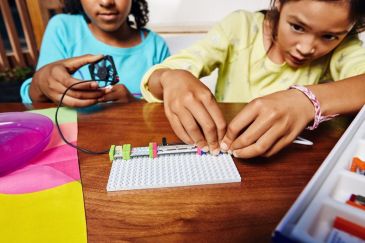
    Makerspace environments can lend themselves to social constructionism following Noss & Clayston’s (2015) characteristics as learning can be designed to socially engage our youth through relevant problem solving activities or challenges. Products and the making process allow learners to socially share their perspectives using language and cultural experiences native to their background. These are the types of activities I have been designing. I have been working and traveling for the last week attempting to take ideas to a mobile makerspace outreach bus to expand research from my previous makerspace projects. .

    This new project seeks to build upon previous NASA MMS research conducted by me through past funding and research that incorporated NASA’s MMS Makerspace Mobile Training Outreach programs, NASA MMS STEAM camp programs, the NASA MMS Challenge, MMS Transmedia book, and MMS Educators Guide. Previous programs provided global professional development for the last four years at ISTE, SITE, Makerspace, ASCD, and TCEA. The mobile STEAM makerspace outreach program developed last year seeks to expand NASA’s MMS Challenge incorporated at NASA’s MMS Launch Event in March 2015 at the Kennedy Space Center, which would serve underrepresented indigenous populations in creative approaches to enhance elementary and middle school community STEM programs. A collaboration between NASA outreach programs, university, community museums, scientific foundations, and industry could assist in building an outreach program exploring in a comparative study general perceptions, confidence levels, and self-efficacy in STEM content areas and career pathways. Improvements in teacher professional development programs would increase the overall student STEM experience in lower and middle school programs.  End results would lead to a highly confident and skilled STEM elementary and middle school workforce, encouraging more students to consider entering a STEM career pathway.

    Ackermann, E. (2001). Piaget’s constructivism, Papert’s constructionism: What’s the difference. Future of learning group publication5(3), 438.

    Avermann, D.  (2011). Some “Wonderings about literacy in teacher education.  In J.B. Cobb, & M. K. Kallus (Eds.), Historical, Theoretical, and Sociological Foundations of Reading in the United States (pp. 13-66). Boston, MA: Pearson.

    Beynon, M., & Roe, C. (2004). Computer support for constructionism in context. IEEE International Conference on Advanced Learning Technologies, 2004.

    Maser, M. (2013, 01 8). Papert led revolution in learning; visionary saw potential of students using computers to explore thte world and themselves. The Vancouver Sun

    Noss, R., & Clayson, J. (2015). Reconstructing Constructionism. Constructivist Foundations10(3), 285-288.

    Papert, S., & Harel, I. (1991). Situating constructionism. Constructionism, 36, 1-11.

    Papert, S. (1999). Papert on piaget. Número especial “The Century’s Greatest Minds,” Time, 29, 105.

    Papert, S. (2000). What’s the big idea? Toward a pedagogy of idea power. IBM Systems Journal, 39(3.4), 720–729. doi:10.1147/sj.393.0720

    Stager, G. S. (2013). Papert’s Prison Fab Lab : Implications for the maker movement and education design, 487–490.


  • Reward Systems May Not Motivate Learners

    Cobb and Whitney’s research (2011) stressed that “contingent rewards initially undermine intrinsic motivation”, while non-contingent rewards may prompt readers to select easy reads (p. 90). My son, Nolan, is an avid fiction reader. He was failing his 7th grade reading class last six weeks because he did not want to read a nonfiction book. My oldest  son, Ezekiel a 9th grader, is in all AP courses. He does not enjoy reading anymore but would always win the AR award for his elementary school. Both of my sons, the creative reader, and the engineer mind, have been failed by the AR system. Luckily, my youngest son loves to read, despite not enjoying the feeling of failure because he is not interested in the books he must read for the AR system. The oldest son was failed because he no longer reads at all unless it is an assignment.

    Apparently, we are not alone. Many feel that reward systems are failing our students. Issues include lack of constructive and meaningful feedback, the selection of AR books, a focus on quizzes and not meaningful discussions about readings. I found a few blogs that really highlight the issues facing students who are being failed by the AR system to include http://blog.penningtonpublishing.com/reading/the-18-reasons-not-to-use-accelerated-reader/.

    Are grades really a reward? I don’t see grades as reward, but grades are a measurement. Grades do not motivate all learners. Unless students are intrinsically motivated, they don’t really care about the grade. Also, what are we measuring?

    Engagement and motivation is key. Assessment as a measurement tool helps us redirect instruction to engage students. AR in my option does not accomplish this for my son. What motivates kids? Sometimes competition works. Other students may not be competitive or care about measuring higher compared to peers.

    Cobb, J. and Whitney, P. (2011) Who is the reader? cognitive, linguistic, and affective factors impacting readers.  In J.B. Cobb, & M. K. Kallus (Eds.), Historical, Theoretical, and Sociological Foundations of Reading in the United States (pp. 13-66). Boston, MA: Pearson.

  • Reflection on Reading in the 20th Century


    What is the difference between the look-say and the phonics approaches to teaching reading. What did the first grade studies tell us about these methods?

    Mitford Mathews’s reading method words-to-reading, or look-say, introduces a large amount of vocabulary words as sight words to the reader. For instance, the teacher would introduce a letter and then provide a list of words and ask the learner to “note or listen for similarity between sounds of letters in each word” (Cobb & Kallus, 2011, p. 16). Matthews look-say method was widely accepted for most of the 20th century. After sight words are introduced, the student would be introduced to analytic phonics, or generalizations, which were applied to a particular sound correspondence.  The idea that readers would respond more rapidly as they recognize whole words, or look-say, rather than a letter-sound relationship.

    Phonics approaches to reading teach the student the sound to say each time they observe a symbol, or a sound to a letter approach. The learner is then motivated to decode words that they encounter. Prior to the first grade studies, reading began in first grade. Sight words, or the look-say method, was used, and analytic phonics introduced. Vocabulary was tightly controlled in grades 1-3, and children worked in small groups. However, the first grade studies highlighted a need to revamp the entire education system, as Chall found that an early code emphasis would be beneficial toward word recognition at an earlier age. As a result, a greater emphasis and intensity was placed on phonics at an earlier age. A change in curriculum was implemented. No longer did schools employ the Dick and Jane approach in first grade. Students were introduced to a wider library collection, to include a focus on children’s literature, with little vocabulary restriction.

    Look at the examples of texts in the table on p. 29. What was the underlying assumption about how reading should be taught for each type of text?

    Each example provides an opportunity for educators to explore how to best help a student learn to read, not to to focus on teaching a student to read, an idea expanded upon by Frank Smith (1971). Smith valued the importance of literacy experiences on cognition and stressed the importance of value texts for early readers.  He also suggested that a mistake was an opportunity to explore the inner workings of the child’s mind, with a focus on cognitive processes and strategies. Each example provides a strategy using value text to assist the teacher. Example one employs patterns, language rhyming,  so that the early reader can predict what is coming next and then understands the meaning. It reminds me of the same principles and strategies that we currently utilize when using a program like flocabulary. It is a great way to introduce vocabulary to students. Students are engaged and can predict what is coming next using language rhyming. The other two examples rely on high frequency words and are the best approach toward engaging beginning readers. Example two utilize rhythm patterns, repetition, and rendition so that the learner can interpreting and interacting with text. Decoding text, the third example, utilize phonics and is not the preferred choice. A beginner can learn one or two words from repetition but do they really know what the words mean? Example one incorporates an improved approach because it encompasses a language rhyme and patterns to help the emerging reader make sense of the words read. It is interesting to me that Smith (1971) warns of the dangers of relying heavily of visuals when so much screen time is placed in front of our students in K-12 environments.

    How does the notion of integrated curriculum relate to the ideas proposed by sociolinguistics?

    Both rely on the premise that perspectives, rooted in cultural heritages, should be valued and contribute toward improving knowledge acquisition through a global lens. Both examples create a more meaningful approach, as differences are valued and not seen as a shortcoming. For example, integrating curriculum can break down barriers between core content areas so that diverse learners can make sense of how each content area contributes to the “real world”. Sociolinguistics adopts this same concept, as the idea values dialects. Integrating dialects exposes learners to new cultures and communities of thought through perspectives. Learners can learn dialects from each other, and as a result, learners develop a better understand of how language differences can contribute toward a better understanding of community. Both approaches create a more globally competent student. In addition, both integrated curriculum and sociolinguistics adopt the idea that reading and language is best understood when put to use for another purpose, learning activity, or event.

    Cobb, J. B., & Kallus, M. K. (2011). Historical, theoretical, and sociological foundations of reading in the united states. Boston, MD: Pearson Education Inc.

    Smith, F. (1971). Understanding Reading: A Linguistic Analysis of Reading and Learning to Read. New York: Holt, Rinehart and Winston.


  • Literacy in Making: Purposeful Makerspaces Connect to All Disciplines

    Many people connect the makerspace movement to STEM (science, technology, engineering, and mathematics) activities through a project-based learning approach. As many are aware, the makerspace movement, founded by Dr. Seymor Papert’s (1991) theory of constructionism, is not a new learning theory or approach. Many schools and programs fail to really embrace the full power of Dr. Papert’s learning theory, which centers around social and intellectual practices to include the skill sets of problem solving, engagement, sharing expertise, and literacy  (Tucker‐Raymond, Gravel, Wagh, Wilson, Manderino,  & Castek, 2016).

    Building Makerspace Literacy Experiences 10_27 (7)

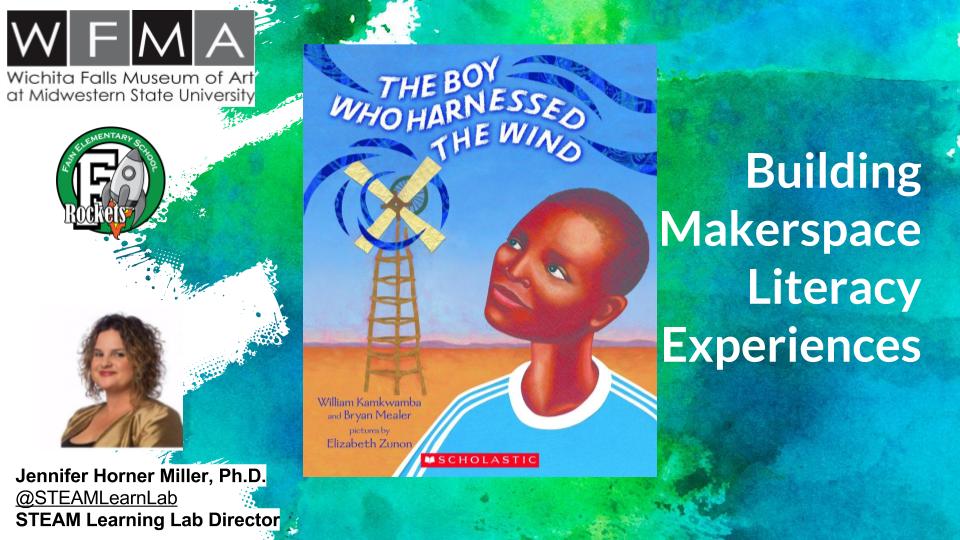
    A recent example of this in practice was provided to elementary teachers during a workshop in north Texas recently. Teachers read the book, The Boy Who Harnessed the Wind.  This book was selected as there is both a chapter version and young readers edition of the true story.  Also, William’s story connects to so many STEM principles that we often see in a makerspace. After reading the story, teachers identified main ideas and concepts, inferences were made, and filled out an upgraded KWL 21st Century Style chart that I have found to be very helpful from Silvia Tolisano (2015). Afterwards, teachers made an artifact serving 1 of four career STEAM roles using the following challenge cards. Afterwards, teachers would reflect via writing.  A link to the presentation and challenge card concept can be located below.

    The following week we implemented this strategy in a Navajo school in northern Arizona. Students were very eager to learn about topics presented and built windmill prototypes and took on a makerspace project using the challenge card concept. Cards were adapted to bring in diversity topics of the Elements, to honor Navajo beliefs and culture.  Navajo students will share their project soon with a larger community.

    Papert, S., & Harel, I. (1991). Situating constructionism. Constructionism36(2), 1-11.

    Tucker‐Raymond, E., Gravel, B. E., Wagh, A., Wilson, N., Manderino, M., & Castek, J. (2016). Making It Social: Considering the Purpose of Literacy to Support Participation in Making and Engineering. Journal of Adolescent & Adult Literacy, 60(2), 207-211.

  • Choose Your Own Adventure.. My Summer Professional Learning Reflections

    Choose Your Own Adventure.. My Summer Professional Learning Reflections

    Anyone involved in public education knows that summers are full of opportunities for educators to embrace professional learning.  Educators and leaders are surrounded with many avenues to model life-long learning. No longer do we have to wait for PD to come to us. This year I had the opportunity to connect and grow my PLN for an entire two months. For the first time in five years, I was not enrolled in graduate courses or completing a dissertation,  free to just learn about any topic of interest and connect. I attended multiple conferences to include Texas ASCD Ignite, ISTE, Denton’s TIA, and immersed myself with exploring content in multiple museums, even visiting the Library of Congress to research the upcoming solar eclipse. Certain themes emerged this summer during my adventure.

    Creativity Matters

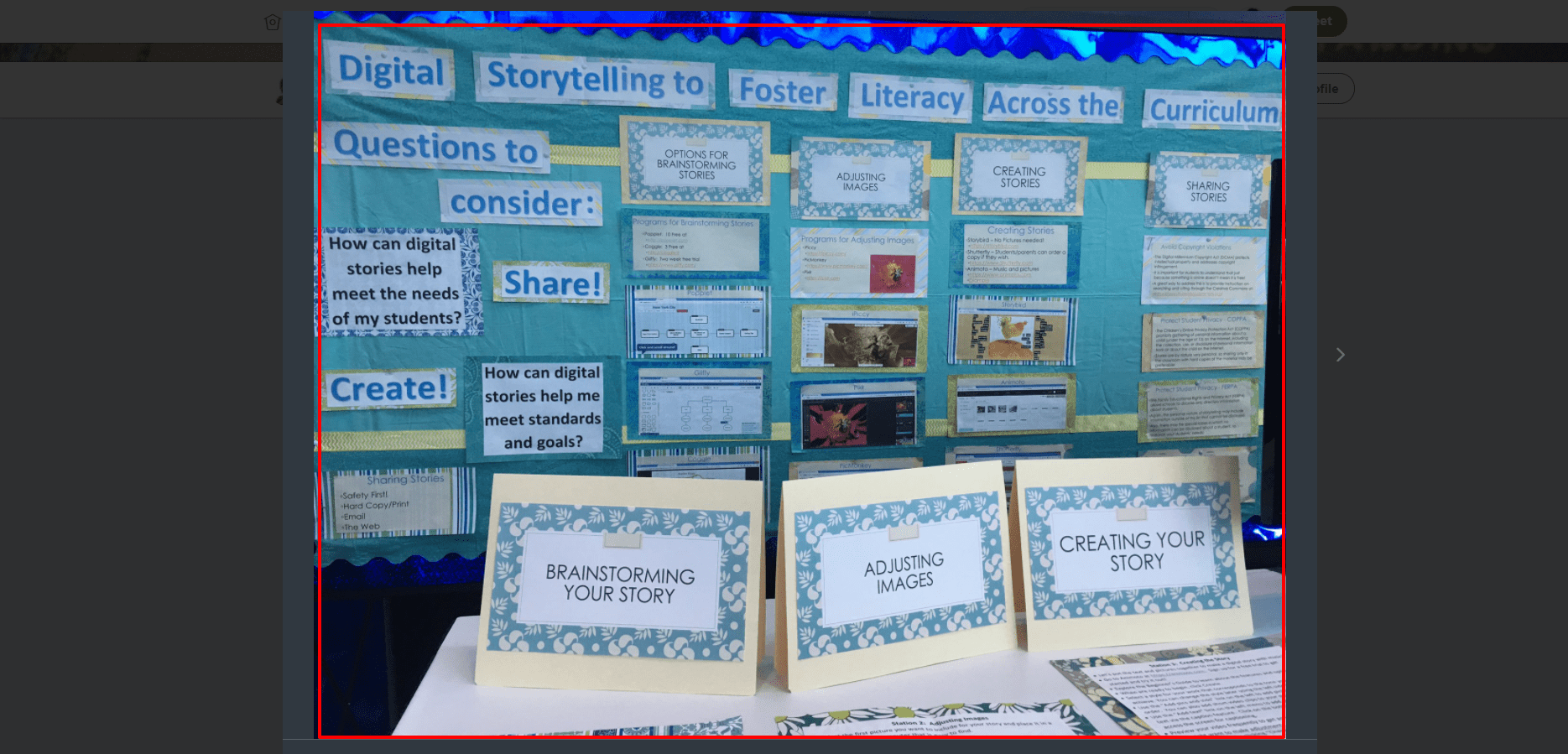
    With so many makerspace, STEM, and STEAM apps, and instructional approaches available to organizations and teachers, choices and program approaches can become overwhelming. It was exciting to see so many great project-based learning approaches centered around storytelling. Many schools are combining storytelling with gaming. For example, it was cool to see how students really engaged with Minecrafting a Colonial City. I liked the following process used toward incorporating digital storytelling with core curriculum.

    Dr Jennifer Miller steamlearnlab Twitter (2)

    Dr Jennifer Miller steamlearnlab Twitter (3)

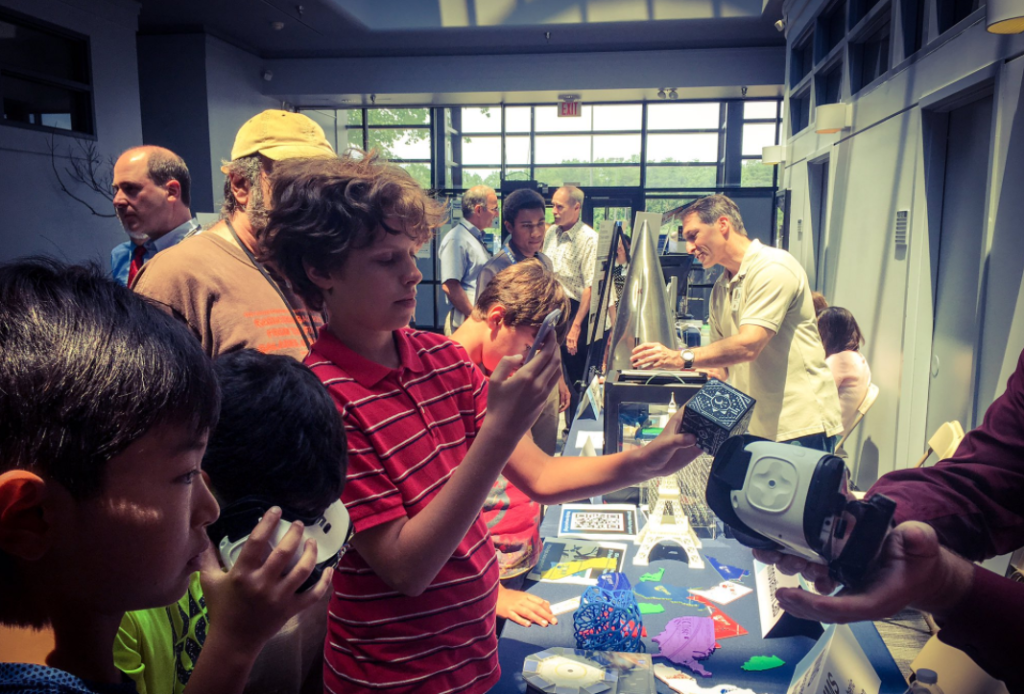
    Lewisville ISD has incorporated a mobile transportation lab, a collaborative unit, serving 70 libraries and STEAM labs. This provides an introduction to educators and students toward creative learning technology approaches. I visited NASA’s STEM Innovation Lab at Goddard Space Center and I was inspired by the many uses of the 3D printer. Learners of all ages were inspired to learn using 3D printed models, which encourages me to continue producing curriculum and 3D printing training programs.

    Dr Jennifer Miller steamlearnlab Twitter (4)

    Transparency Matters

    Eric Schlesinger always inspires. He recently provided a keynote at Denton TIA in which he reminded us that transparency really does matter. I have been a heavy user at times of social media, blogging, and at times have had to unplug. Often those whom are very plugged in are criticized for bragging. However, Eric reminds us that branding your story isn’t only ok, it is necessary toward being transparent and building trust. In fact, telling your story connects learning to stakeholders. He reminded us of the importance of being transparent and consistent with our posts. During the last two years, I had dropped my professional blog posts. After hearing him speak last week, I decided to pick up my blog and begin consistently posting once a week. Hopefully, this exercise will increase my ability to communicate digital learning and cognitive science approaches to all stakeholders. Change does not come from opinions. Change is brought about by the examples we set and our reactions toward others.

    Community Matters

    It is important to remember that the teacher makes the difference! It was very inspiring to see how teachers at WELD Re-4 School District deliver a creative conference in which students, business leaders, and educators provide professional learning sessions to the entire community. A result of this program included a new scholarship program,  innovations scholarships, which are provided toward students who demonstrate quality interactive student showcases.

    The final takeaway for this summer is that true learning is FUN! I am very grateful to have had this opportunity to learn and connect with so many around the world. This is going to be an amazing school year!


  • Exploring Advanced Instructional Design iCARE, Blooms, and Backwards Design Models

    Image
    Building Connections…

    iCARE Instructional Design Model

    Rhonda Ritter’s presentation on the iCARE instructional design model provides an excellent framework to utilize with secondary/post-secondary students.  The iCARE model, from my perspective,  builds strong connections to 21st century learning skill sets. iCARE consists of a simple and flexible design approach.  iCARE  (Introduction, Connect, Apply, Reflect, and Extend) provides students with  answers to why learning content is needed and how content extends to “real world” scenarios.  Students often need to extend reflections to a larger audience. Students who often lack motivation to earn or make the grade, and iCARE provides an external motivator that could push students towards lifelong learning.  Online learning environments offer a variety of collaborative platforms, and the iCARE model could easily provide learning communities an improved online environment to “showcase” and extended learning to a larger audience.

    Backwards Design

    Brenda Quintanilla provided a strong presentation on how the Backwards Design model improves instruction by aligning objectives to final outcomes.  Backward design suggests that learning design should should begin with  a final assessment in mind.  Backward design attempts to ensure that students meet the expected outcomes or course goals.   While I agree that aligning is very important, instructors must be cautioned to not “teach to the test.”  Drill and kill approaches often fail to inspire students to apply content to real world scenarios or approaches.  Goals are important, but assessment driven instruction can become repetitive.  Educators and instructors perhaps need training on best practices on using Backward Design approaches.  The following link can help improve Backward Design approaches.

    Blooms Taxonomy

    Christina Gilliam’s provided an informative review of how Blooms order of domain has shifted to include remembering, understanding, applying, analyzing, evaluating, and creating.   Gilliam’s presentation included key domain questions  and verbs to consider.

    Integration and community approaches using technology can potentially provide differentiated instruction efficiently.  Training and coaching on best Blooms practices using technology will continue to be a high need.  Instructional designers can assist teachers with how to apply advanced instructional models using learning technologies.

    Blooms Model applied to iPod/iPad Apps

    Nice Wiki on Advanced Instructional Design and Learning Technologies

    This image has been sourced from http://www.usi.edu/distance/bdt.htm.

    (more…)