Category: Uncategorized

  • Reflection on Reading in the 20th Century


    What is the difference between the look-say and the phonics approaches to teaching reading. What did the first grade studies tell us about these methods?

    Mitford Mathews’s reading method words-to-reading, or look-say, introduces a large amount of vocabulary words as sight words to the reader. For instance, the teacher would introduce a letter and then provide a list of words and ask the learner to “note or listen for similarity between sounds of letters in each word” (Cobb & Kallus, 2011, p. 16). Matthews look-say method was widely accepted for most of the 20th century. After sight words are introduced, the student would be introduced to analytic phonics, or generalizations, which were applied to a particular sound correspondence.  The idea that readers would respond more rapidly as they recognize whole words, or look-say, rather than a letter-sound relationship.

    Phonics approaches to reading teach the student the sound to say each time they observe a symbol, or a sound to a letter approach. The learner is then motivated to decode words that they encounter. Prior to the first grade studies, reading began in first grade. Sight words, or the look-say method, was used, and analytic phonics introduced. Vocabulary was tightly controlled in grades 1-3, and children worked in small groups. However, the first grade studies highlighted a need to revamp the entire education system, as Chall found that an early code emphasis would be beneficial toward word recognition at an earlier age. As a result, a greater emphasis and intensity was placed on phonics at an earlier age. A change in curriculum was implemented. No longer did schools employ the Dick and Jane approach in first grade. Students were introduced to a wider library collection, to include a focus on children’s literature, with little vocabulary restriction.

    Look at the examples of texts in the table on p. 29. What was the underlying assumption about how reading should be taught for each type of text?

    Each example provides an opportunity for educators to explore how to best help a student learn to read, not to to focus on teaching a student to read, an idea expanded upon by Frank Smith (1971). Smith valued the importance of literacy experiences on cognition and stressed the importance of value texts for early readers.  He also suggested that a mistake was an opportunity to explore the inner workings of the child’s mind, with a focus on cognitive processes and strategies. Each example provides a strategy using value text to assist the teacher. Example one employs patterns, language rhyming,  so that the early reader can predict what is coming next and then understands the meaning. It reminds me of the same principles and strategies that we currently utilize when using a program like flocabulary. It is a great way to introduce vocabulary to students. Students are engaged and can predict what is coming next using language rhyming. The other two examples rely on high frequency words and are the best approach toward engaging beginning readers. Example two utilize rhythm patterns, repetition, and rendition so that the learner can interpreting and interacting with text. Decoding text, the third example, utilize phonics and is not the preferred choice. A beginner can learn one or two words from repetition but do they really know what the words mean? Example one incorporates an improved approach because it encompasses a language rhyme and patterns to help the emerging reader make sense of the words read. It is interesting to me that Smith (1971) warns of the dangers of relying heavily of visuals when so much screen time is placed in front of our students in K-12 environments.

    How does the notion of integrated curriculum relate to the ideas proposed by sociolinguistics?

    Both rely on the premise that perspectives, rooted in cultural heritages, should be valued and contribute toward improving knowledge acquisition through a global lens. Both examples create a more meaningful approach, as differences are valued and not seen as a shortcoming. For example, integrating curriculum can break down barriers between core content areas so that diverse learners can make sense of how each content area contributes to the “real world”. Sociolinguistics adopts this same concept, as the idea values dialects. Integrating dialects exposes learners to new cultures and communities of thought through perspectives. Learners can learn dialects from each other, and as a result, learners develop a better understand of how language differences can contribute toward a better understanding of community. Both approaches create a more globally competent student. In addition, both integrated curriculum and sociolinguistics adopt the idea that reading and language is best understood when put to use for another purpose, learning activity, or event.

    Cobb, J. B., & Kallus, M. K. (2011). Historical, theoretical, and sociological foundations of reading in the united states. Boston, MD: Pearson Education Inc.

    Smith, F. (1971). Understanding Reading: A Linguistic Analysis of Reading and Learning to Read. New York: Holt, Rinehart and Winston.



  • Homeschool Cover-Up Of Dropout Problem

    Heather's avatarBecoming Worldly

    So this PBS article is an exposé on how the state of Texas is cheating on its dropout numbers to the point of where some schools have listed zero dropouts. While this finding is understandably embarrassing to Texas education officials, and likely infuriating to Texas parents and students who have worked hard to have that diploma and rightly believe it should mean something, this brings up another issue closer to home for me: homeschooling is being used as the preferred method of cheating.

    Obviously this is not okay. It’s a huge problem to have homeschooling serve as this kind of a loophole. It reduces credibility and sends too many “homeschooled” students out into the world who can both be expected to reflect badly on the concept of homeschooling, and consigns too many young people to struggle as human beings with a sub-par education.

    It is unconscionable that underperforming public schools…

    View original post 865 more words

  • Literacy in Making: Purposeful Makerspaces Connect to All Disciplines

    Many people connect the makerspace movement to STEM (science, technology, engineering, and mathematics) activities through a project-based learning approach. As many are aware, the makerspace movement, founded by Dr. Seymor Papert’s (1991) theory of constructionism, is not a new learning theory or approach. Many schools and programs fail to really embrace the full power of Dr. Papert’s learning theory, which centers around social and intellectual practices to include the skill sets of problem solving, engagement, sharing expertise, and literacy  (Tucker‐Raymond, Gravel, Wagh, Wilson, Manderino,  & Castek, 2016).

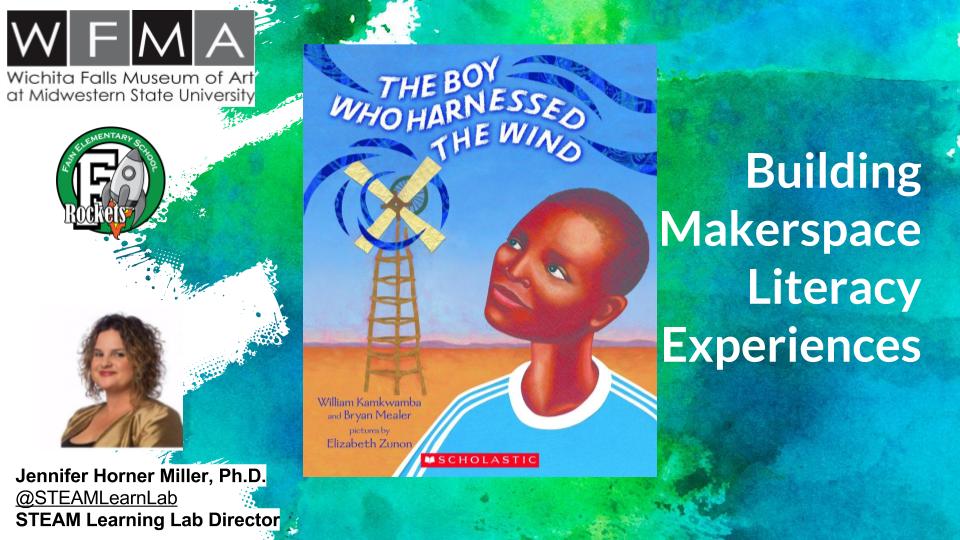
    Building Makerspace Literacy Experiences 10_27 (7)

    A recent example of this in practice was provided to elementary teachers during a workshop in north Texas recently. Teachers read the book, The Boy Who Harnessed the Wind.  This book was selected as there is both a chapter version and young readers edition of the true story.  Also, William’s story connects to so many STEM principles that we often see in a makerspace. After reading the story, teachers identified main ideas and concepts, inferences were made, and filled out an upgraded KWL 21st Century Style chart that I have found to be very helpful from Silvia Tolisano (2015). Afterwards, teachers made an artifact serving 1 of four career STEAM roles using the following challenge cards. Afterwards, teachers would reflect via writing.  A link to the presentation and challenge card concept can be located below.

    The following week we implemented this strategy in a Navajo school in northern Arizona. Students were very eager to learn about topics presented and built windmill prototypes and took on a makerspace project using the challenge card concept. Cards were adapted to bring in diversity topics of the Elements, to honor Navajo beliefs and culture.  Navajo students will share their project soon with a larger community.

    Papert, S., & Harel, I. (1991). Situating constructionism. Constructionism36(2), 1-11.

    Tucker‐Raymond, E., Gravel, B. E., Wagh, A., Wilson, N., Manderino, M., & Castek, J. (2016). Making It Social: Considering the Purpose of Literacy to Support Participation in Making and Engineering. Journal of Adolescent & Adult Literacy, 60(2), 207-211.

  • Cultivating Ideas via Makerspace

    Last week I was fortunate to collaborate with an amazing Makerspace community, known as the Makerspot, led by NRH Public Library Director Cecilia Barham located in north Texas. I began this blog post but failed to publish it.  Teachers not only connected with the makerspace community, they were challenged to make a product, that connected to main ideas and concepts in their content area, serving the role of a journalist, engineer, artist, or scientist.  Teachers selected an article, book, or play and began to make a product.  Afterwards, teachers shared their products or ideas to the makerspace community. Take aways included the following.

    Makerspace Centers On Community

    It is important to remember that a true makerspace is a community of makers, not relying on just one leader or participant. When a makerspace becomes a shared space of leaders sharing their craft, all students benefit. Many schools fail to understand this. As a result, the makerspace becomes a club or after school program. While this does provide many benefits, the lack of shared ownership can result in the makerspace facilitator feeling overwhelmed. In addition, when the sponsor leaves, so does the program. Perhaps, the largest issue is the lack of connection to classroom content. Connecting teachers to the space provides a platform to enrich curriculum and shared ownership.

    (more…)

  • How to Submit a Podcast to Google Play

    podbean's avatarPodbean Blog

    Podcasts are now available (released in the U.S. and Canada currently) on Google Play Music. You can submit your Podbean-hosted audio podcasts so you can be found there! Go to Google Play to submit your RSS feed. You will need to 1. Add your RSS feed, 2. Confirm ownership, and 3. Publish.

    1

    You need to have at least 1 episode published and have the appropriate tags set up in Podbean:, or , and or (Podbean supports the iTunes tags, which work for both iTunes and Google Play). Login to google and “add a podcast”. If you don’t know your RSS, simply go to Settings→Feed/iTunes in your Podbean dashboard. At the top you will see “Your RSS feed” (http://yourname.podbean.com/feed/).

    After submitting your RSS feed, you will need to “confirm email” (via the email in the RSS feed). Check for the email from Google and click on the “verify ownership” button (or…

    View original post 74 more words

  • How to Get People Involved in Training? — Guila Muir and Associates

    What’s the best way to assure your training participants groan inwardly and “turn off” the first second you open your mouth? Simply by following conventional wisdom about how to open a training session: introduce yourself and provide your credentials. Instead, generate curiosity, interest and motivation from the outset. Use a “Hook” before introducing yourself. (Participants […]

    via How to Get People Involved in Training? — Guila Muir and Associates

  • The 5 Best iPad Podcasting Apps for Students

    jonathanwylie's avatarJonathan Wylie

    ipad podcasting apps title

    If recent predictions are to be believed, the podcasting scene will explode in 2016. For me, that’s great to hear because I am a big fan of podcasts, but it is also great news for teachers who are looking for new ways for their students to communicate their ideas and reach a global audience. So, with that in mind, here are some of the best apps for podcasting on the iPad.

    What is Podcasting?

    Depending on who you ask, the definition of podcasting can vary. Some people think they are podcasting when they record audio, but to most who are familiar with podcasting, this leaves out one important aspect, namely the ability to reach that global audience. So, here’s a definition I like from the Oxford Dictionary.

    The practice of using the Internet to make digital recordings of broadcasts available for downloading to a computer or mobile device.

    View original post 1,028 more words

  • STEM K12 Research Initiatives and Teacher Preparation Programs

      As STEM education gaps continue, US STEM occupations have increased four times the rate of total employment (Batts & Lesko, 2011). According to the 2010 President’s Council of Advisors on Science and Technology, funding and research targeted to address challenges include a two-pronged approach, to prepare all students to have a rich foundation in STEM and to inspire and motivate students to learn about STEM subjects in hopes more choose to enter a STEM career field (Raju & Clayson, 2010). The purpose of this paper is to explore K12 research and curriculum approaches to improving teacher preparation, which will assist in creating positive student perceptions and interest towards STEM and STEM career pathways using an online MOOC platform.

    The following full academic paper presentation explores current literature and research exploring face to face and MOOC STEM teacher training programs.