Tag: Camp

  • Don’t Stop Believing…Leading Change Through ACTION

    Today I had the privilege of spending the entire day with Eric Sheninger. He encouraged us to consider who will tell our story if we don’t. What will they say?

    That was an important and scary question for me to consider right now. I am gun shy as my major professor stated. My story is an amazing story and I have been blessed to meet and work with some amazing educators. This is my perspective from past experiences. I have seen kids make a very large impact in the world . I have been so blessed to identify my passions early on and to have had a creator put special opportunities in my path along with some amazing kids, teachers, and leaders.

    Assisting the community of Dublin, Texas with  Dr. Shaun Barnett and his wife Keri Barnett with a 1:1 K12 technology initiative in 2010, I became a leader. I am grateful to both of them for their leadership.  I believe this was the 2nd 1:1 K12 initiative in the state of Texas. Serving as the district instructional technologist and grant coordinator and later under a different leader a technology coordinator, I became a connected educator. I found myself working and leading the state in, dare I say the word, Project Share (the state’s first attempt for a connected Learning Management system) with Ms. Barnett. At that time, I had no one really in the area or Texas to connect with or to assist me. We brought in Alan November and Apple to assist in training.  What did I do? I joined a PhD program to connect with the top scholars of the world and began using social media to include Project Share, LinkedIn, Twitter, and Facebook. I  located people to assist me in understanding how to connect others to content. I became a passionate curator, creator, researcher, publisher, and scholar and feel as if I was blessed to oversee some amazing transformations. No one really understood what I was doing, but now I believe we planted a seed for not just a rural community, but for an entire global movement.

    Project Share: It didn’t work out, but the concept was right on. The ability for all students in Texas to have a digital portfolio via an LMS in which stakeholders could communicate and introduce blended learning was futuristic. I submitted a proposal and was surprised when we were selected to serve on a panel at the first SXSWedu conference. Yes, the LMS platform was flawed, Epsilen, but the IDEA of sharing was truly noble and ahead of it’s time. However, I found change slower than expected and a lack of understanding on the concept of connected learning. In fact, at the end of the experience after hours of free assistance from me to the Epsilen team, my participation in focus groups, and a public push for improved LMS features and training ,  I  found that I had lost my ability to even post or share with a wider network within Project Share. What did I do? I turned to other tools like Canvas and continued my passion to assist in helping others see the power of open source and communication.

    Student Voice: I remember introducing the concept of video creation with Samuel Parsi from Apple in a Challenge Based Learning PD. From that students began creating video and we were invited to lead change via a Ignite session in Austin in 2012 in the Digital Square. I remember taking students to TCEA 2012 in Austin in which my friends Randy Rogers, Dwight Goodwin, Mark Hooker, and Scott Floyd invited my students to participate in an Ignite session on their cause to TAKE 5: 5 Ways to Change Your Community and their efforts to QR code their 5 small museums. We used Google Maps to track our cause, which became eventually a Save Dublin campaign, #saveddp. Their efforts to save their rural town through digital curation left a huge impact. Mark invited our students to the first TED student event and we saw our first 3D printer. That led to a NASA STEAM camp program, which at that time and to my knowledge was the first STEAM camp program in Texas. 

    Makered and STEAM: No one in 2012 understood the maker movement. I am grateful to Whitney and Tom Kilgore who invited me to be to host some of the first #txeduchat events, all focused on STEAM and makered ideas. Those ideas assisted us last year in leading the entire world with the first student NASA launch parties . We also hosted a Google Hangout to reflect on STEAM programs.

    From this experience, I was able to take ideas to the Kennedy Space Center. This month I found myself leading makercamp at the Dallas Perot Museum and again saw kids amazed to create 3D objects for 3D printing for the first time in the Perot Learning Lab. During their makerspace, kids were amazed and so excited to see everyone enjoying their reflections.

    I was invited to Washington DC last October to lead a social media event at a NASA clean room facility. What did I do? I didn’t shut out the students and take it in just for myself. I brought the kids in, thankfully with Mr. Chris Underwood and Bea Price. They agreed to Skype with me all day and I believe that was the first time at a NASA press conference that Skype was used  during public questioning. We had 5th graders asking tough questions to some of the top heliophysics experts of the world.

    Even though I have had been afforded all of these opportunities, I found myself during this entire time wondering if I could continue the charge. It is hard to be a bright light within an institution and at times hard to overcome obstacles, barriers, fear, efforts to control innovative change. It is hard to remain positive. Change is difficult . Managing my time and focus had become difficult along with maintaining a belief that I could be positive and actually continue in the public education sector.

    This spring I had many opportunities to move to the private sector. I have had some leaders tell me “Your too bright to be in public education.” “Jennifer, you need to be at a university.” “There is no future in public education, everything is moving to charter and online options because the system is broken.”

    I say to these naysayers, I BELIEVE in everyone’s right to an equal opportunity and the spirit of public education. I BELIEVE in YOU. I BELIEVE in our CHILDREN. I AM GRATEFUL  and WE WILL SUCCEED.
    Focus on Positive

  • Renew, Reuse, Recycle with NASA’s Multiscale Magnetosphere Mission using Fabrication Printing

    STEAM (Science, Technology, Engineering, the Arts/Agriculture, and Mathematics) after school programs serve as a fantastic tool to generate interest and to think about how the core sciences integrate nicely with liberal arts studies to solve real world problem scenarios.  STEAM camps provide students with a fun learning approach in which topics are explored, researched, and presented to promote true differentiated learning. Dublin Intermediate and Junior High hosted a second annual STEAM camp  last month.  Dublin is a rural community located in central Texas, and is working to learn more about solar energy with NASA education’s Multiscale Magentosphere team, the Perot Museum, Tarleton State University, and the University of North Texas.  Students were exposed to vocabulary concepts related to NASA’s Magnetosphere Mission and reflected using the arts.  Vocabulary approaches were emphasized the first day of STEAM camp and  included the following stations:  Technology Games for Vocabulary, the Art of Vocabulary, MMS Spacecraft  Vocabulary Game, and Creating an iBook Glossary.  Integration Tools that were utilized during the first building block included the following.

    Spelling City

    ePals

    Flash Card Stash

    Keynote

    Students were exposed to a variety of science integration lessons were students learned about magnetic force and the sun.  Rockets were built and launched within a space crew.  Professors, researchers, the public librarian, TX Dot engineers, artists, and NASA engineers were brought in to meet with students daily.  In fact, students had the privilege to meet Laurence Gartel, the Father of Digital Art.  Students built a solar oven, roasted s’mores, and reflected by creating magnetic art using iPods.

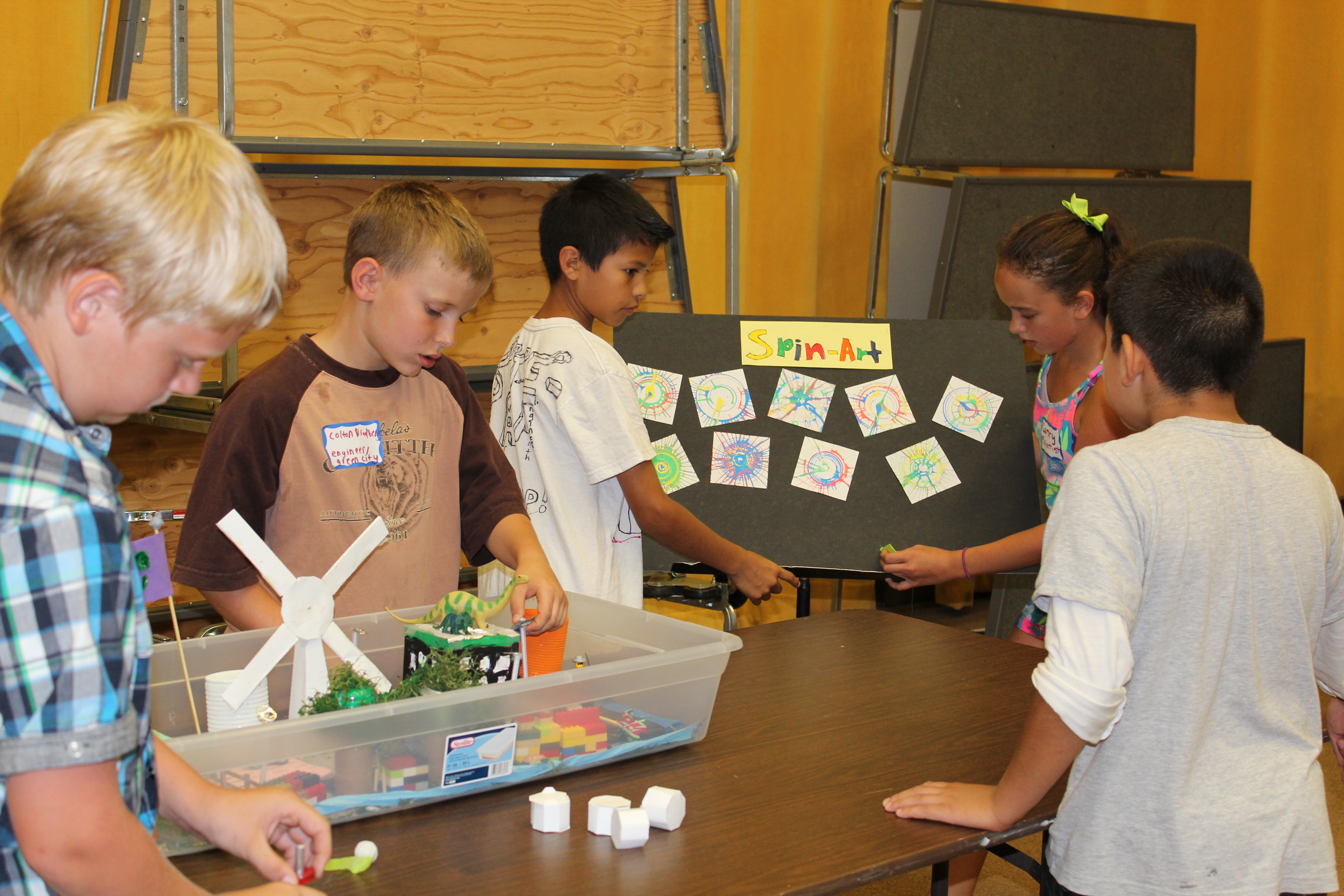
    Career guest speakers were brought in virtually and in person throughout the camp experience.  Guest speakers shared how topics like magnetic force, measurement, force and motion, green economics, and the creative arts connect to their real professional lives.  Students were exposed to TED’s William Kamkwamba to learn about the power of thought, action, and belief in reusing items in existence to build a useful object to help a community.  Students were then exposed to Make To Learn resources and Fab Lab and were challenged to build a windmill.  Young engineers built Lego NXT robots during STEAM camp.  Crews were challenged to build a green city using either recycled trash or Legos.  Most crews chose to use recycled trash and Fab Lab to build a green city.  STEAM camp participants were fortunate to have the opportunity to visit the Perot Museum to learn more about renewable energy and participated in Biofarming for Fuel.  As a final exercise, students replicated NASA’s Transmedia MMS labs to build a scaled version of NASA’s MMS spacecraft.  Tarleton State University hosted a space lounge exhibit at the Fine Arts Center in late June were crews led a student museum exhibit and served the role of an artist, engineer, scientist, or journalist to teach the public at large about renewable energy, magnetic force, and NASA’s MMS 2014 mission.  The experience was shared at an academic research conference exchange and at the International Society of Technology Education 2013 conference in San Antonio in June.  A special thank you to Tarleton State University, the University of North Texas, the Perot Museum, and NASA for giving students this once in a lifetime experience.  Image

  • Sun + Technology + Earth + Art + MMS = NASA Sun Earth Day Celebration

    Students that participated in Dublin/RYSS’s Joint Art Workshop in the spring of 2012 utilized solar weather data images provided by NASA to produce digital art that was used for the backdrop during NASA Edge’s press conference held to celebrate Sun Earth Day 2013.  Tom Chamber’s students attending RYSS and DISD students researched academic vocabulary related to space weather and the sun to develop a working knowledge and purpose surrounding the mission.  Students from RYSS traveled to DISD to teach students how to utilize GIMP and utilize NASA data images to create a personal reflection surrounding the mission.

    Dublin Independent School District is located in central rural Texas and is beginning its second year studying about NASA’s MMS (Magnetospheric Multiscale (MMS) mission).  Students are learning about solar weather, earth’s magnetosphere, and magnetic force.  Students participating in DISD’s STEAM (Science, Technology, Engineering, the Arts, and Mathematics, 2012 camp experienced joint PD with teachers learning 21st Century skills and STEAM career opportunities.

    STEAM camp produced much excitement in Dublin during the fall of 2012, and students formed a robotics club to focus on the engineering components.  Students attended their first robotics competition, hosted a MARS party to teach skills to a neighboring district, and participated in PIE (partners in education) showcase during the spring of 2013.

    DISD will host another STEAM camp during June of 2013 to learn more about how the sun can be utilized as a renewable energy source.  Students in Texas were very excited to see their work showcased yesterday.

    NASA’s MMS Educational Resources 

    Creativity Tools

    ISTE NASA MMS Challenge

    STEAM Resources

    NASA EDGE Sun Earth Day 

    Dublin ISD/RYSS NASA Edge Webcast

  • Instructional Design for STEAM Camp

    STEAM Academic Camp:  TAP (Topics, Audience, and Purpose)

    Topics

    Careers in Science, Art, and Technology:  Exploring Career Opportunities in STEAM


    Learn To Talk Like An Astronaut:  Building Scientific Academic Vocabulary


    Fun With Magnets:  Understanding Magnetic Force


    What Is The Big Deal With Space Weather?   


    You Be The Teacher:  Checking for Understanding


    Creating eBook Reflections:  Reflecting on Solar Storms, MMS Mission, Magnetic Force, Career Opportunities, and extended learning field trips


    Building a Zip Line


    Designing and programing a Robot


    Building a Community Showcase


    Purpose:


    Students will be placed in small groups and will learn about the process and purpose of the MMS mission so that students understand the background of magnetic force, space weather, auroras, solar storms, careers, and the MMS Mission.  Afterwards, students can complete the MMS Challenge and create a community showcase.  Students and teachers will learn how STEAM affects all content areas during this exercise.  Teachers will also be placed in small groups and will pick the area that they feel would benefit them the most in the classroom next fall and/or area of interest. 


    Audience 4-6 grades students:  STEAM (Science, Technology, Engineering, Art, and Math)


    NEEDS


    Instructor Needs:  Introduction to objectives and purpose of STEAM camp, science vocabulary on NASA’s MMS mission, options for integration tools for teachers to facilitate, concerns, training on integration apps and how to build an eBook, Questions and connections to content area needed., strategies to evaluate student work and progress.   


    Student Needs:  Engaging activities that are “camp” like that will expose students to new academic vocabulary that address diverse learning styles, hands on activities, planning, communication with parents,  inclusion of multicultural activities and perspectives, options on choices for students, feedback from students, student evaluation strategies. 


    Environmental Resources:  iPads, iPods, and MacBook Airs, Lego WeDo and Lego NXT systems, Smart Boards, Projectors, and Speakers, paper, markers, art supplies, tape, and Legos.


    Instructors are being trained daily on different skill sets, and these 18 teachers received training on Tuesday June 12 and Wednesday June 13 from 4:00-5:00 PM. 


    Learning Expectations:


    Course Goals and Objectives:


    Learning goal 1.0:  Students will explore scientific academic vocabulary and on solar storms, auroras, the sun, scientific method, and the Earth’s magnetosphere. 


    Objective 1.1:  Students will create an informative video on the meaning of their favorite scientific vocabulary term relating to solar storms, auroras, scientific method, the sun, or the Earth’s magnetosphere.


    Learning goal 2.0:  Students will conduct collaborative research and apply the scientific method to evaluate results. 


    Objective 2.1:  Students will research from a variety of preselected resources in collaborative groups questions important to the background of NASA’s MMS Mission on solar storms, the sun, the Earth’s magnetosphere, MMS Mission,  and the scientific method.


    Objective 2.2:  Students in collaborative groups will create an instructional presentation from research.  Research presentations will be published and shared to a mobile audience. 


    Learning goal 3.0:  Students will explore and experiment with magnetic fields following the scientific method. 


    Objective 3.1:  Students will create their own magnet following the scientific method approach.   


    Objective 3.2:  Students will create their own compass to further understand magnetic force following the scientific method approach. 


    Objective 3.3:  Students will create an ebook in collaborative groups to reflect learning experiences. 


    Learning goal 4.0:  Students will understand robotic design concepts, practice teamwork, apply problem solving, and understand simple machine language.


    Objective 4.1:  Students will plan, design, build, and work as teams to have a lego bicycle ride a zip line.


    Objective 4.2:  Students will be able to identify and understand how math and science applies to simple machines. 


    Objective 4.3:  Students will design, build, and work as teams to build a robot.


    Objective 4.4:  Students will be able to modify and problem solve to enhance their robotic production.


    Objective 4.5:  Students will be able to program their robot to utilize sensors. 


    Learning goal 5.0:  Students will explore career pathways and opportunities in the field of STEAM. 


    Objective 5.1 Students will develop questions to ask an expert in the field of STEAM: scientist, artist, journalist, technologist, engineer, or architect.  Questions will be shared electronically. 


    Learning Activities: 


    1. Students will think about questions to ask a career professional in the area of STEAM. 
    2. Students will record pre-interview questions for a professional in their career interest.
    3. Students will interview via video conference/in person a professional in the field of STEAM. 
    4. Students will pick their favorite scientific word from an academic word wall.
    5. Students will research the word to find the scientific meaning and create a vocab video on the meaning of the word using 3-5 images.
    6. Students will explore magnets and magnetic force.  Students will build an electro-magnet following the scientific method.  Students will record reflections.
    7. Students will explore and research topics related to the sun and solar weather.   Students will understand how to predict solar weather and review past solar weather activity to compare and contrast solar weather reporting and solar weather impact on human life. 
    8. Students will create an informative eBook from experiences in Careers, solar weather, academic vocabulary, and magnetic force learning experiences.
    9. Students will conduct a pre-evaluation on what they know and/or need to know about robotic systems.

    10. Students will become familiar with robotic kits, classroom management of robotics, and

    11. Students placed in teams will problem solve to build a zip line.

    12. Students will plan, design, and build a robotic system.

    13. Students will program their robotic system to utilize a sensor.

    14. Students in teams will plan, coordinate, and produce a  community showcase or museum exhibit based on complete learning experiences . 


    Assessment: 


    Scientific Community Showcase


    Evaluation: 


    Peer Review, Student Self Evaluations, Reflections


    Timeline/Calendar: All training with teachers is small group based. 


    June 4:  Teacher PD On purpose of STEAM camp, MMS mission purpose, and practiced 21st century skills:  Worked You Be The Teacher and was given a STEAM camp overview.


    June 11:  STEAM camp kick off with Digital artist, ice breaker activities, and participate in You Be the Teacher, Learn To Talk Like An Astronaut, and Fun With Magnets. 


    Teacher training after camp on what is the Big Deal with Space Weather, Careers in Science, Art, and Technology.


    Juen 12:  STEAM Camp:  Build paper rockets, What is the Big Deal with Space Weather, Careers in Science, Art, and Technology, You Be the Teacher, Learn to Talk Like an Astronaut , and Fun With Magnets.


    Teacher Training:  Using Gimp for Academic vocabulary, Using Animoto for Vocabulary and Video Production, Blogging tools and Introduction to iPad Apps


    June 13:  MMS Challenge with students at STEAM camp


    Teacher Training:  Building an eBook, Design a Zip Line


    June 14-17:  NASA trip, teachers and students will build an eBook


    June 19:  eBook Reflections with students, Design a Zip Line


    Teacher Training:  Strategies to help student design and  Build a Community Showcase


    June 22:  Build a Community Showcase Event


    Student Evaluations Daily


    Teacher Training and Learning Evaluations:  June 11 and June 22