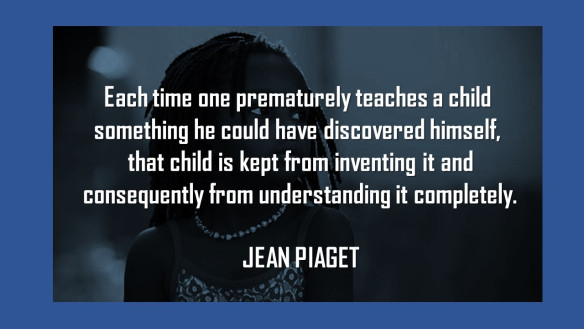
Personal learning theories on how children and adults best learn are often deeply rooted in past experiences, knowledge, and personal convictions (Ackermann, 2001). We had the unique opportunity to actually hear our great scholar’s explain questions of why and how to address learning as a science. Good (2011) was correct to point out the importance of teachers understanding the cognitive science and theories behind the learning process. This is essential toward improving the instructional design that Skinner speaks of in the video. Learning theories related to how children learn have existed since ancient times. Traditional behavioral learning theories stress the importance of the instructor. Knowledge is transmitted from the mind of the teacher, through lectures and words, imprinted to the student. Learning in a behaviorist’s perspective is a passive experience centered on memorization. Active learning theories evolved from traditional approaches. Piaget’s “Constructivism” continues to have far reaching implications to many modern theories. Constructivism centers on the thought that “knowledge is constructed within the learner’s mind on the basis of existing knowledge and new experiences” (Mavridis, Al Rashdi, Al Ketbi, Al Ketbi, & Marar, 2009). It was wonderful to view Piaget explain his own theories in the video Piaget on Piaget.
What do I believe about the science of learning?
Cognitive development and deep understanding are the foci of constructivism rather than emphasizing behaviors and skills (Fosnot & Perry, 1996). Social Constructivism, an extension of Piaget’s learning theory, stresses that learning is a meaningful and collaborative process employing a variety of perspectives (Smith & Ragan, 2005). Papert’s “Constructionism is a learning theory that adopts constructivist views, but also holds that learning happens most effectively when people are active in making objects to share in the real world” (Mavridis et al., 2009). Constructionism is a learning theory that considers the design as part of the building process. Constructionism allows learners to “dive into unknown situations,” introducing new perspectives (Ackerman, 2001). Constructionism principles outlined by Burbaite, Stuikys, and Damasevicius (2013) provide a framework to approaching e-learning environments.Prior knowledge impacts learning and knowledge is constructed, connecting to constructivist learning theory.Learning and knowledge occurs through the design of meaningful and authentic projects, creating an internal desire to learn.Learning is a process centering on integration of concepts from different realms of knowledge.Building and manipulating objects engage learners to connect and explore the world.Reflection on a learner’s form of understanding is a key component to learning. The above principals center on Papert’s ideas that “learning by making” is effective, allowing learners to construct, or elaborate, thereby providing richness and deeper learning experiences (Papert & Harel, 1991).Constructionist environments support “active learning” approaches in which learners are engaged in building their own public objects or artifacts. Active learning emphasizes cognitive processes occurring during the actual construction of the object. The public nature of the final object or artifact is also understood to be important (Beynon & Roe, 2004). The “maker movement emphasizes learning through direct experiences, hands-on projects, inventions, and is based on a constructionist learning theory even if members and advocates of the movement are unaware of the theory” (Stager, 2013). Papert (2000) advocates that Piaget’s belief of all learning takes place in discovery is accurate. However, Papert extends this idea to suggest that setting learners “to the task of re-empowering the ideas of being learned is also a step toward re-empowering the idea of learning by discovery” (p. 723). Papert (1999) underscores the importance of Piaget’s theory of constructivism and the nature of knowledge.How does this theory assist with understanding toward reading and cognitive processing?To be honest this is the area of improvement that I am working on. I have a strong cognitive science background, but Vaden (2013) presents us with a strong argument as to why teachers need to understand “neurological functioning of struggling readers” (p. 174) Brain science is fascinating and knowing how to address cognitive and behavioral skills during instruction can prove to be invaluable to any educator. For instance, strategies associated with word recognition should center around linking symbols with sounds, as research has linked “fluency to associating symbols with sounds” (Vaden, 20130, p. 181). It is exciting to learn that exposure to quality instructional design can profoundly increase reading comprehension.
How does this theory assist with understanding toward reading and cognitive processing?To be honest this is the area of improvement that I am working on. I have a strong cognitive science background, but Vaden (2013) presents us with a strong argument as to why teachers need to understand “neurological functioning of struggling readers” (p. 174) Brain science is fascinating and knowing how to address cognitive and behavioral skills during instruction can prove to be invaluable to any educator. For instance, strategies associated with word recognition should center around linking symbols with sounds, as research has linked “fluency to associating symbols with sounds” (Vaden, 20130, p. 181). It is exciting to learn that exposure to quality instructional design can profoundly increase reading comprehension. How can we provide this type of quality instructional experience? I believe we need to improve teaching education programs that address learning as a science, require quality professional development programs, and improve our instructional approaches to target issues and personalize intervention.
Ackermann, E. (2001). Piaget’s constructivism, Papert’s constructionism: What’s the difference. Future of learning group publication, 5(3), 438.
Beynon, M., & Roe, C. (2004). Computer support for constructionism in context. IEEE International Conference on Advanced Learning Technologies, 2004.
Burbaite, R., Stuikys, V., & Damasevicius, R. (2013, July). Educational robots as collaborative learning objects for teaching Computer Science. In System Science and Engineering (ICSSE), 2013 International Conference on (pp. 211-216). IEEE.
Edley, N. (2001). Unravelling Social Constructionism. Theory & Psychology, 11(3), 433–441.
Fosnot, C. T., & Perry, R. S. (1996). Constructivism: A psychological theory of learning. Constructivism: Theory, perspectives, and practice, 8-33.
Good, K. (2013). Intersections of educational psychology and the teaching of reading: connections in the classroom. In J.B. Cobb, & M. K. Kallus (Eds.), Historical, Theoretical, and Sociological Foundations of Reading in the United States (pp. 13-66). Boston, MA: Pearson.
Mavridis, N., Al Rashdi, A., Al Ketbi, M., Al Ketbi, S., & Marar, A. (2009, December). Exploring behaviors & collaborative mapping through Mindstorms robots: A case study in applied social constructionism at senior-project level. In Innovations in Information Technology, 2009. IIT’09. International Conference on (pp. 284-288). IEEE.
Papert, S. (1999). Papert on piaget. Número especial “The Century’s Greatest Minds,” Time, 29, 105.
Papert, S. (2000). What’s the big idea? Toward a pedagogy of idea power. IBM Systems Journal, 39(3.4), 720–729.
Smith, P. L., & Ragan, T. J. (2005). Foundations of Instructional Design. In, Instructional Design.
Stager, G. S. (2013). Papert’s Prison Fab Lab : Implications for the maker movement and education design, 487–490.
Vanden, S. R. (2013) The brain and reading. In J.B. Cobb, & M. K. Kallus (Eds.), Historical, Theoretical, and Sociological Foundations of Reading in the United States (pp. 13-66). Boston, MA: Pearson.
What did you learn from your experience using social media and other open source tools? Should they be used for teaching and learning? Tell the story of what you learned
Social media has changed my approach to learning, both a student and as an educator. I can leverage social media to collaborate, research, publish, and extend learning beyond my local environment. Also, I am allowed to showcase a reflection to a wider audience and this motivates me to want to learn and share more. Self directed learning is empowering. The social element provided within social media environments allow for a more free flowing approach to communication (Taylor, King, & Nelson, 2012). The freedom of information via social media provides educational platforms to users and students across the world. This presents both advantages and disadvantages to learning.
In a recent study, Fewkes & McCabe (2012) surveyed students and found that majority of participants, 73%, believed Facebook could be used as an educational tool, citing benefits to include collaboration, homework assistance, productivity, and easier communication. However, only 27% of students surveyed had a teacher include Facebook in a learning activity. This to me signifies the largest issue facing schools. Teachers have had little training on how to integrate technology and social media into instructional activities. The learning curve is rapidly changing, Instructors need to not only learn how to utilize social media tools to advance their own personal learning, and they now must also leverage social media tools to facilitate a deeper learning experience. This requires strong professional development, time and support.
It is important that a teacher be present online and involves students to become both producers and contributors within a social media environment. Ignoring social media doesn’t provide solutions and fails students. Teachers and schools must model 21st century skill sets to students. Educational programs should promote social media tools and demonstrate appropriate use to a wider community. How will students choose to utilize social media tools if they are not exposed to using tools to advance a quest for knowledge? Social media provides classrooms with an opportunity to increase cognitive presence, teacher presence, and social presence, providing a more meaningful learning experience.
In 2010, I was a participating in a Twitter educational chat when I began corresponding with other educators about integration practices. From this experience, I was provided a link to a program in which my life significantly changed. Due to a Twitter PLN, I found myself two months later working on a curriculum packages with top ed tech and science teachers. Our product was shared with the world using a variety of tools via Twitter, Facebook, Skype, and Google+. A direct result of me participating in a self directed Twitter edtech chat, led me towards coauthoring curriculum and sharing experiences to the entire world. As a result, I decided to attempt to earn a PhD in Learning Technologies and cognitive systems. In addition, students in rural Texas received funding and recognition. Twitter has significantly changed the playing field. There is now a living conversation that continues on topics I am passionate about. I get to collaborate with like minded professionals about real world problems and we seek solutions. I have learned that I am not alone. There are many teachers eager to change the world and make a difference. Many instructional technologists feel alone and pioneers in the field often do find themselves struggling to meet demands. It is difficult to be in the trenches, but the reward of learning outcomes shared within a social environment is worth is great.
Hunter & Caraway (2014) illustrate the importance of participating in social networking, as tools are becoming a very popular place for 21st century youth to construct, articulate, and participate in their own reality. Young people are already involved in fundamental acts of teaching and learning and employ social media to do so. Hunter & Caraway (2014) conducted a study with 30 ELA ninth grade and 10th grade students in an urban area, using Twitter as a means to have students organize, facilitate, and disseminate topics related to literacy and literature. Students became more engaged, and participation increased. Students appreciated experiences and developed academic identities, which was previously missing.
Hashtags provide students with a voice. I attempted to give students this ability in a rural town in Texas. I will never forget the day our Tweets landed a local DFW reporter in our classroom. We led a national campaign to help our rural community gain attention. Students developed a campaign and for 3 months began creating content, videos, and utilizing social media to save a local business. Students utilized the TwitterMapApp and we could see our message spreading over the world. Students became very engaged and began to care about learning. We could see visually see on Twitter and on the map the power of an idea and were able to view a movement take place. This was a powerful event in which I had the privilege of facilitating.
I have learned that social media can be utilized to provide for a richer learning experience. It levels the playing field, provides students with the ability to construct new knowledge by giving students access to multiple perspectives. Reflections are very empowering, and it is important that K12 classrooms help students develop an academic identify online. I have learned that those who ignore this problem will find themselves still encountering issues associated with social media. Reimagning instructional approaches employing social media platforms are essential to producing a transformative 21st century learning environment.
Be a participant, producer, reader, and contributor. Model appropriate learning and share experiences. Social media platforms serve to help push our students to become academic contributors.
Hunter, J. D., & Caraway, H. J. (2014). Urban youth use twitter to transform learning and engagement. English Journal, 103(4), 76-82.
Fewkes, A. M., & McCabe, M. (2012). Facebook: Learning Tool or Distraction?. Journal Of Digital Learning In Teacher Education, 28(3), 92-98.
Taylor, R., Dr, King, F., Dr, & Nelson, G., Dr. (2012). Student learning through social media. Journal of Sociological Research, 3(2), 29-35.
A course was designed for current K-12 teachers and instructional technologists recently as part of our PhD research towards our personal learning theory. With modification, this course could easily translate to instruction for pre-service teachers.
The purpose of the course was to provide professional development (PD) training regarding DigiFab technology and potential instructional uses for quick and efficient implementation.
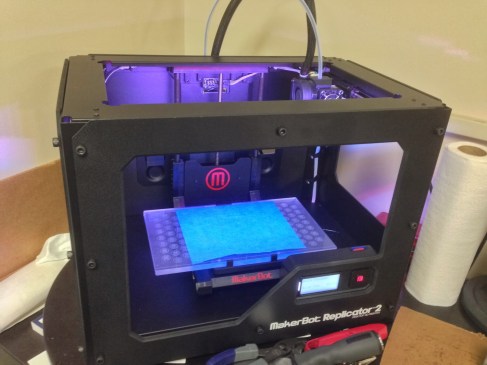
The following problem was explained by my partner Jared Vanscoder and I. A resurgence of the constructivist approaches to teaching and learning has created a demand for a solution that requires little knowledge of manufacturing processes, aids visualization through tangible representation, and speeds prototyping. Digital fabrication technologies, such as 3D printing, are garnering much attention as they afford users to simply create tangible artifacts from digital model files. This capability is enticing as an tool for teaching and learning in K-12. Given the newness of this technology, very few K-12 instructors (or even instructional technologists) are aware of how these technologies can increase engagement and instructional impact on learners.
The format of our course is designed as stand-alone instruction to be delivered in two separate formats: face to face (F2F) and online. The option of hybrid (components being delivered both F2F and online) should also be considered.
How hard is it to develop a research method that both matches your theory and created curriculum?
The activity allows learners to create order or reorganize information to construct new meaning. Learners construct knowledge, as a builder would begin building a structure. Fabrication technologies facilitate concepts of abstraction, allowing the learner to build or fabricate an actual object or model. It was not hard to match my personallearning theory to fabrication curriculum. After all, fabrication does lend itself to modeling and objects created with such a technology provide for a more meaningful approach to learning. Allowing participants to choose a “real world” scenario or object to reconstruct also fosters an active learning event, which provides further depth and richness in cognitive presence.
What was simple and what was difficult?
Creating an online instructional PD approach via problem based learning instructional design model within an e-learning context proved to be challenging. However, Jared and I are committed to being pioneers in the field of Learning Technologies and Cognitive Systems met challenges head on and worked to overcome. The overall product is very strong, with instructional goals met. However, time spent to accomplish learning goals online proves to be more intensive then a face-to-face environment. The overall learning potential I feel is greater in an online e-learning format as it forces the learner to seek solutions and not rely as heavily on an actual face to face community of learners. We suggested a reflection piece of the assessment component. Motivating teachers to complete a reflection at the end of the assessment piece may prove to be challenging. In addition, not seeing a 3D printer and only sending an STL file to post in a blog or learning management system may not be as effective as actually having access to a 3D printed product. Equitable access may prove to be a limitation within the online learning environment for fabrication PD approaches. I feel this activity challenged both Jared and I to think outside the box. As two educators and online students, we understand difficulties presented within the e-learning environment. However, the benefits of the e-Learning activity far outweigh disadvantages. Teachers are exposed to the very learning theory and instructional design methods proven to provide a rich learning experience using learning technologies that foster abstract thinking or cognitive development. Overall, I am very proud of our product. Hopefully, we can test our approach in a qualitative case study.
 Dr. Jennifer Miller-Ray