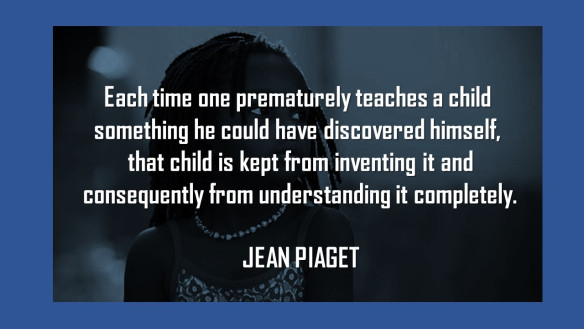
Personal learning theories on how children and adults best learn are often deeply rooted in past experiences, knowledge, and personal convictions (Ackermann, 2001). We had the unique opportunity to actually hear our great scholar’s explain questions of why and how to address learning as a science. Good (2011) was correct to point out the importance of teachers understanding the cognitive science and theories behind the learning process. This is essential toward improving the instructional design that Skinner speaks of in the video. Learning theories related to how children learn have existed since ancient times. Traditional behavioral learning theories stress the importance of the instructor. Knowledge is transmitted from the mind of the teacher, through lectures and words, imprinted to the student. Learning in a behaviorist’s perspective is a passive experience centered on memorization. Active learning theories evolved from traditional approaches. Piaget’s “Constructivism” continues to have far reaching implications to many modern theories. Constructivism centers on the thought that “knowledge is constructed within the learner’s mind on the basis of existing knowledge and new experiences” (Mavridis, Al Rashdi, Al Ketbi, Al Ketbi, & Marar, 2009). It was wonderful to view Piaget explain his own theories in the video Piaget on Piaget.
What do I believe about the science of learning?
Cognitive development and deep understanding are the foci of constructivism rather than emphasizing behaviors and skills (Fosnot & Perry, 1996). Social Constructivism, an extension of Piaget’s learning theory, stresses that learning is a meaningful and collaborative process employing a variety of perspectives (Smith & Ragan, 2005). Papert’s “Constructionism is a learning theory that adopts constructivist views, but also holds that learning happens most effectively when people are active in making objects to share in the real world” (Mavridis et al., 2009). Constructionism is a learning theory that considers the design as part of the building process. Constructionism allows learners to “dive into unknown situations,” introducing new perspectives (Ackerman, 2001). Constructionism principles outlined by Burbaite, Stuikys, and Damasevicius (2013) provide a framework to approaching e-learning environments.Prior knowledge impacts learning and knowledge is constructed, connecting to constructivist learning theory.Learning and knowledge occurs through the design of meaningful and authentic projects, creating an internal desire to learn.Learning is a process centering on integration of concepts from different realms of knowledge.Building and manipulating objects engage learners to connect and explore the world.Reflection on a learner’s form of understanding is a key component to learning. The above principals center on Papert’s ideas that “learning by making” is effective, allowing learners to construct, or elaborate, thereby providing richness and deeper learning experiences (Papert & Harel, 1991).Constructionist environments support “active learning” approaches in which learners are engaged in building their own public objects or artifacts. Active learning emphasizes cognitive processes occurring during the actual construction of the object. The public nature of the final object or artifact is also understood to be important (Beynon & Roe, 2004). The “maker movement emphasizes learning through direct experiences, hands-on projects, inventions, and is based on a constructionist learning theory even if members and advocates of the movement are unaware of the theory” (Stager, 2013). Papert (2000) advocates that Piaget’s belief of all learning takes place in discovery is accurate. However, Papert extends this idea to suggest that setting learners “to the task of re-empowering the ideas of being learned is also a step toward re-empowering the idea of learning by discovery” (p. 723). Papert (1999) underscores the importance of Piaget’s theory of constructivism and the nature of knowledge.How does this theory assist with understanding toward reading and cognitive processing?To be honest this is the area of improvement that I am working on. I have a strong cognitive science background, but Vaden (2013) presents us with a strong argument as to why teachers need to understand “neurological functioning of struggling readers” (p. 174) Brain science is fascinating and knowing how to address cognitive and behavioral skills during instruction can prove to be invaluable to any educator. For instance, strategies associated with word recognition should center around linking symbols with sounds, as research has linked “fluency to associating symbols with sounds” (Vaden, 20130, p. 181). It is exciting to learn that exposure to quality instructional design can profoundly increase reading comprehension.
How does this theory assist with understanding toward reading and cognitive processing?To be honest this is the area of improvement that I am working on. I have a strong cognitive science background, but Vaden (2013) presents us with a strong argument as to why teachers need to understand “neurological functioning of struggling readers” (p. 174) Brain science is fascinating and knowing how to address cognitive and behavioral skills during instruction can prove to be invaluable to any educator. For instance, strategies associated with word recognition should center around linking symbols with sounds, as research has linked “fluency to associating symbols with sounds” (Vaden, 20130, p. 181). It is exciting to learn that exposure to quality instructional design can profoundly increase reading comprehension. How can we provide this type of quality instructional experience? I believe we need to improve teaching education programs that address learning as a science, require quality professional development programs, and improve our instructional approaches to target issues and personalize intervention.
Ackermann, E. (2001). Piaget’s constructivism, Papert’s constructionism: What’s the difference. Future of learning group publication, 5(3), 438.
Beynon, M., & Roe, C. (2004). Computer support for constructionism in context. IEEE International Conference on Advanced Learning Technologies, 2004.
Burbaite, R., Stuikys, V., & Damasevicius, R. (2013, July). Educational robots as collaborative learning objects for teaching Computer Science. In System Science and Engineering (ICSSE), 2013 International Conference on (pp. 211-216). IEEE.
Edley, N. (2001). Unravelling Social Constructionism. Theory & Psychology, 11(3), 433–441.
Fosnot, C. T., & Perry, R. S. (1996). Constructivism: A psychological theory of learning. Constructivism: Theory, perspectives, and practice, 8-33.
Good, K. (2013). Intersections of educational psychology and the teaching of reading: connections in the classroom. In J.B. Cobb, & M. K. Kallus (Eds.), Historical, Theoretical, and Sociological Foundations of Reading in the United States (pp. 13-66). Boston, MA: Pearson.
Mavridis, N., Al Rashdi, A., Al Ketbi, M., Al Ketbi, S., & Marar, A. (2009, December). Exploring behaviors & collaborative mapping through Mindstorms robots: A case study in applied social constructionism at senior-project level. In Innovations in Information Technology, 2009. IIT’09. International Conference on (pp. 284-288). IEEE.
Papert, S. (1999). Papert on piaget. Número especial “The Century’s Greatest Minds,” Time, 29, 105.
Papert, S. (2000). What’s the big idea? Toward a pedagogy of idea power. IBM Systems Journal, 39(3.4), 720–729.
Smith, P. L., & Ragan, T. J. (2005). Foundations of Instructional Design. In, Instructional Design.
Stager, G. S. (2013). Papert’s Prison Fab Lab : Implications for the maker movement and education design, 487–490.
Vanden, S. R. (2013) The brain and reading. In J.B. Cobb, & M. K. Kallus (Eds.), Historical, Theoretical, and Sociological Foundations of Reading in the United States (pp. 13-66). Boston, MA: Pearson.
Today I had the privilege of spending the entire day with Eric Sheninger. He encouraged us to consider who will tell our story if we don’t. What will they say?
That was an important and scary question for me to consider right now. I am gun shy as my major professor stated. My story is an amazing story and I have been blessed to meet and work with some amazing educators. This is my perspective from past experiences. I have seen kids make a very large impact in the world . I have been so blessed to identify my passions early on and to have had a creator put special opportunities in my path along with some amazing kids, teachers, and leaders.
Assisting the community of Dublin, Texas with Dr. Shaun Barnett and his wife Keri Barnett with a 1:1 K12 technology initiative in 2010, I became a leader. I am grateful to both of them for their leadership. I believe this was the 2nd 1:1 K12 initiative in the state of Texas. Serving as the district instructional technologist and grant coordinator and later under a different leader a technology coordinator, I became a connected educator. I found myself working and leading the state in, dare I say the word, Project Share (the state’s first attempt for a connected Learning Management system) with Ms. Barnett. At that time, I had no one really in the area or Texas to connect with or to assist me. We brought in Alan November and Apple to assist in training. What did I do? I joined a PhD program to connect with the top scholars of the world and began using social media to include Project Share, LinkedIn, Twitter, and Facebook. I located people to assist me in understanding how to connect others to content. I became a passionate curator, creator, researcher, publisher, and scholar and feel as if I was blessed to oversee some amazing transformations. No one really understood what I was doing, but now I believe we planted a seed for not just a rural community, but for an entire global movement.
Project Share: It didn’t work out, but the concept was right on. The ability for all students in Texas to have a digital portfolio via an LMS in which stakeholders could communicate and introduce blended learning was futuristic. I submitted a proposal and was surprised when we were selected to serve on a panel at the first SXSWedu conference. Yes, the LMS platform was flawed, Epsilen, but the IDEA of sharing was truly noble and ahead of it’s time. However, I found change slower than expected and a lack of understanding on the concept of connected learning. In fact, at the end of the experience after hours of free assistance from me to the Epsilen team, my participation in focus groups, and a public push for improved LMS features and training , I found that I had lost my ability to even post or share with a wider network within Project Share. What did I do? I turned to other tools like Canvas and continued my passion to assist in helping others see the power of open source and communication.
Student Voice: I remember introducing the concept of video creation with Samuel Parsi from Apple in a Challenge Based Learning PD. From that students began creating video and we were invited to lead change via a Ignite session in Austin in 2012 in the Digital Square. I remember taking students to TCEA 2012 in Austin in which my friends Randy Rogers, Dwight Goodwin, Mark Hooker, and Scott Floyd invited my students to participate in an Ignite session on their cause to TAKE 5: 5 Ways to Change Your Community and their efforts to QR code their 5 small museums. We used Google Maps to track our cause, which became eventually a Save Dublin campaign, #saveddp. Their efforts to save their rural town through digital curation left a huge impact. Mark invited our students to the first TED student event and we saw our first 3D printer. That led to a NASA STEAM camp program, which at that time and to my knowledge was the first STEAM camp program in Texas.
Makered and STEAM: No one in 2012 understood the maker movement. I am grateful to Whitney and Tom Kilgore who invited me to be to host some of the first #txeduchat events, all focused on STEAM and makered ideas. Those ideas assisted us last year in leading the entire world with the first student NASA launch parties . We also hosted a Google Hangout to reflect on STEAM programs.
From this experience, I was able to take ideas to the Kennedy Space Center. This month I found myself leading makercamp at the Dallas Perot Museum and again saw kids amazed to create 3D objects for 3D printing for the first time in the Perot Learning Lab. During their makerspace, kids were amazed and so excited to see everyone enjoying their reflections.
I was invited to Washington DC last October to lead a social media event at a NASA clean room facility. What did I do? I didn’t shut out the students and take it in just for myself. I brought the kids in, thankfully with Mr. Chris Underwood and Bea Price. They agreed to Skype with me all day and I believe that was the first time at a NASA press conference that Skype was used during public questioning. We had 5th graders asking tough questions to some of the top heliophysics experts of the world.
Even though I have had been afforded all of these opportunities, I found myself during this entire time wondering if I could continue the charge. It is hard to be a bright light within an institution and at times hard to overcome obstacles, barriers, fear, efforts to control innovative change. It is hard to remain positive. Change is difficult . Managing my time and focus had become difficult along with maintaining a belief that I could be positive and actually continue in the public education sector.
This spring I had many opportunities to move to the private sector. I have had some leaders tell me “Your too bright to be in public education.” “Jennifer, you need to be at a university.” “There is no future in public education, everything is moving to charter and online options because the system is broken.”
I say to these naysayers, I BELIEVE in everyone’s right to an equal opportunity and the spirit of public education. I BELIEVE in YOU. I BELIEVE in our CHILDREN. I AM GRATEFUL and WE WILL SUCCEED.
Attempting to understand the evolution of learning technologies is complicated. Thomas Edison’s idea of moving pictures spawned many learning opportunities produced new knowledge and learning technologies. The market model of research has produced a new world where information is cheaper and easily obtained.
Why is it so hard to get schools to adopt learning technologies? This is not a new question or concern. From literature review, it was interesting to learn that the overhead projector is one of the few examples of learning technologies implemented in the school industry first. The challenge facing instructional designers to try new ideas and approaches and to encourage use is not a new phenomenon, which I find encouraging as an instructional technologist.
Research approaches and opportunities are numerous as the adaption process continues to be a struggle. Reflecting on my personal experience, I found it difficult to even locate a 1:1 K5 campus in Texas two years ago. Motivational factors that can improve the adoption process need to be studied to ensure that change is productive and leads to newly acquired direction and knowledge. How can we better match the needs of users? How can we better include users in the selection of learning technologies?
Blended approaches that consider global perspectives are often philosophical in nature. Philosophical reflections from descriptive, normative, and analytic methods assist in developing new questions and ideas to then quantify.
Educational research follows natural laws of science. Educational research is a field of science that attempts to define the human ability to transfer knowledge from one individual to another individual, from one individual to a group, from a group to a single individual, a group to another group. Learning technologies are carriers or storage vessels used to aide individuals ability to transfer knowledge.
Descriptive studies using surveys are often biased, contain leading questions, and many do leave out nonresponders. Surveys have to be purposeful. Interviews, observational research, and questionares must focus on questioning techniques and population. Approaches using visuals to summarize data was interesting to me. The arts again lends itself to be the universal medium to foster communications.
 Dr. Jennifer Miller-Ray