Tag: Education

  • Considering Online Course Delivery: A Graduate Learning Technology Student Perspective

    Why have we moved so many courses online?

    Mobile platforms provide flexibility to a growing global market of adults seeking to improve skill sets needed within a 21st century workforce. Cellular applications used to access online learning content, along with the deliver of MOOCS, offer students convenient approaches to learning online. Globalization combined with an emerging demand from a previously absent third world population within the post secondary market will continue to push for increased access to online learning. Improvements in communication technologies along with increased access in rural environments allow for new markets and platforms to fulfill an ever increasing demand to online education.

    Online learning platforms include the following choices to training and higher ed institutions.

    Canvas is a free, very sleek and is attractive to users.  It is a very user friendly, providing simplicity.  Social media can be integrated within the system, which is very appealing to students and instructors.

    Schoology is an excellent approach to online learning and offers many advantages to students to include a simple and collaborative user interface.  Did I mention that it is also FREE?  Mobile applications are limited with this feature.

    Moodle includes a great new mobile app platform and continues to offer access to quality LMS to a growing online learning population. Moodle’s layout and mobile features has greatly improved and continues offer quality LMS options  globally for FREE.

    Blackboard has upgraded services and is offering a free online course management system, CoursSites.  However, unlike Moodle you are limited to 5 courses per log in.

    As students, do you feel like online courses are as good as face-to-face courses?

    As a student, having an instructor, human, actively participating within the course is a must.  The relationship between a teacher and a student is the most important factor in determining success.  Online courses can be as good as face to face courses when the instructor encourages online dialogue and communication within the course environment.  Video face to face weekly meetings, along with a simple and organized approach to delivery can provide this option.  A true learning community must exist in either learning environment.  This is why MOOCS will not completely replace instructors as students need a quality learning experience.

    What are the major differences between online and FTF courses for you as a student?

    A major difference between online and FTF courses is the frequency of interaction within the learning community.  Again, a MOOC does not provide frequent quality dialogue.  Students must be more disciplined when participating in an online environment, questioning and seeking solutions.  It is easier to do so within a face to face environment.  Learning curves exist when trying a new LMS platform or when updates to existing platforms occur.  Instructors can mitigate these issues by posting help features within the course.

    Whether you have taught one or not, what do you think the differences are for the instructor? How do we know if the formats require different skills or result in different learning outcomes? Do we?

    Instructors should choose features and integrate files that work across mobile platforms.  In addition, providing recordings to assist students who may need to refer back to information during the course is helpful.  Learning curves are perhaps larger for instructors, as technologies and LMS platforms change constantly.  University and corporate institutions should consider providing support and training options regularly to share best practices within the organization.

    Image

    Some links that I found  interesting regarding the growth of online learning are located below.

    http://www.uis.unesco.org/education/Pages/international-student-flow-viz.aspx

    http://edition.cnn.com/2013/06/21/business/opinion-koller-education-petersburg-forum/

    http://harvardmagazine.com/2013/12/harvard-mit-online-education-views-changing
     

  • Exploring MUVEs in K12 Environments

    Working with an atmosphere of high stakes testing, time needed to direct students towards instructional engaging students using MUVE (Multi-User Virtual Environments) is limited.  How can leaders promote the use of MUVE in an after school program?  Would such a program be engaging?  Would students gain valuable knowledge participating in after school instructional MUVEs?

    MUVE’s can foster collaboration and learning communities.  Jones & Warren’s (2011) study demonstrates tough challenges facing K12 teachers interested in pursing MUVE integration approaches, with only one of nine research participants able to move forward to utilize a MUVE with students.  Little research can be found to support integration of MUVEs in the K12 classroom, and there is a strong need to show that such environments improve academic yearly progress (p. 6).

    Sardone & Devlin‐Scherer (2008) point out that developers often fail to consider learning processes and first consider the user not the learning process.  Further research on learning outcomes is needed in this area.  Students do spend a lot of time after school accessing participating in a MUVEs.  Could developers and ed tech corporations leverage games and MUVEs to produce a more knowledgable society by considering first the learning process during design?   How can we leverage after school K12 time using MUVE’s to enrich learning experiences?  The market exists.   Perhaps a generation of STEAM learning designers, scientists, programmers and digital artists are needed.  It would be very interesting to have students recreate history like the example here, Teachers Discovering History As Historians.

    Are you interested in virtual gaming in an after school tutorial program?  Here are some K12 resources.

    Multi User Environment Educational Resources

    MindCraft Educational Resources

    Jones, G. & Warren, S. J. (2011), ‘Issues and Concerns of K-12 Educators on 3-D Multi-User Virtual Environments in Formal Classroom Settings.’, IJGCMS 3 (1) , 1-12 .

    Sardone, N. B., & Devlin‐Scherer, R. (2008). Teacher candidates’ views of a multi‐user virtual environment (MUVE). Technology, Pedagogy and Education, 17(1), 41–51. doi:10.1080/14759390701847484

  • Improving the Value Added Model of Public Education

    How do we measure the value of learning experiences? Student enrollment, classroom grade performance, standardized test scores, job placement, and completion rate are all variables researchers examine to try to better address school improvement.  How do educational technology products improve the overall learning experience for students?  With so many approaches to addressing the need for improvement, we continue to rely on task oriented activities and solutions, which students fail to understand.  Often these approaches and solutions lack meaning.  Is value purely economic or social?  Why is education important?  What should students learn?  Why shouldn’t we raise expectations?  Many agree that change is needed.  The current system is leaving so many students without economic opportunity and students fail to see the purpose or lack interest in becoming “enlightened.”

    Dialogue, discourse, and collaboration are key to understanding how information can be used to solve a problem and classroom environments, both online and face to face, should be encouraged.

    Crabbe (2007) suggests the following instructional guidelines to assist in adding learning value to tasks, which gives students the ability to manage learning and view learning as an opportunity.  “Provide direct instruction in the big picture of how to add private learning value to tasks by presenting the full range of language learning opportunities.  Do not assume that one public performance on a task is ever sufficient. A task is a starting point—a learner should understand how to add value to the task themselves. Frequently model in class time on how to add value to tasks by identifying and demonstrating specific private learning activities deriving from the public part of the task. Provide independent study time to try these activities in class and explain their anticipated effects.  Give time for learners to discuss difficulties experienced in their performance on a task and how they might address those difficulties through rehearsal.  Discuss affective factors that might affect opportunity take-up, particularly lack of self-confidence, uncertainty of goal, feeling foolish. Suggest strategies to overcome these inhibiting factors.  Write private learning opportunities into materials so that they become an explicit part of the script and thus prompts for teachers to explore the opportunities with learners.  Give status to private learning by assessing the learners on how well or how often they have taken up opportunities, possibly through learning logs” (Crabbe, 2007, p. 120-122).

    Crabbe, D. (2007). Learning opportunities: adding learning value to tasks. ELT Journal, 61(2), 117–125. doi:10.1093/elt/ccm004

    Ken Robinson: Changing education paradigms

  • Giving students a voice….

    One way to engage students is by giving students a voice. Technology can really help facilitate learning because it provides multiple communication channels that the teacher can use to give students a voice (who may not otherwise engage), which empowers them to take ownership in their learning. A larger audience can allow for the student to extend learning outside of the classroom. Technology is not the answer to academic issues. We must use it in a meaningful way that motivates students to think. Our task is to create a new generation of problem solvers and critical thinkers. Technology must facilitate higher order thinking activities. You can find a lot of “junk” technology activities that are not engaging or fun, especially linear activities.

    Some other thoughts: We have to be careful not to crush student ideas, voices, etc. We don’t always “know” better. Stand and deliver style of teaching does fit is some cases, but we need to spend less time presenting and more time allowing kids to If you truly value student voice, they must know that their ideas can direct the path to learning. Think about how you can give your students a global voice. How do we build a career focus, or career voice, to produce college ready graduates? Students must know that you believe in them. We must show that we like what we are teaching and what we teach. Choose learning technologies that give students a voice and allow them to contribute not just work linearly to contribute only to themselves, you, or a grade. Are we spending all of our time on compliance and standardization? Don’t be boring, push beyond the easy and comfortable. Students are often willing to choose boring over taking a risk. Expect students to do exciting things. Recognize boring and redirect, remove the safe option. Foster joy, we should all be laughing more because kids learn in a happy environment. An expert recently told me that we should incorporate the 5 model, Engage, Explore, Explain, Elaborate, Evaluation. Their suggestion was to move the first 3 online, and that will save you time for elaboration and evaluation. The flip concept is only a system, the strategy of 5 e is still needed from you. You and your relationship with students is still the most important motivating factor. If you want to use a flip system, you must question, elaborate, and evaluate in class. Videos alone will not address learning issues. You must expect students to do their part and follow through. It does work and is working in many areas in the nation and state. However, teaching is still the most important component.

    Some ideas:

    1. Creating a how to video and blog (written) evaluation reflections: Great alternative formal assessment tool. I am very proud of Debra Miller’s leadership in creating a video to publish on the junior high web page. A parent called this morning very excited to see the video. Keep up the excellent work.

    2. Twitter: Students from one district last night led a state wide twitter chat on giving students a voice. Twitter widgets on your website really interest students. Teaching students how to act professionally online can be modeled in this way. Check out #txed hash tag to view how students led a very professional collaborative discussion on this topic. We have Dublin High School students using twitter and I enjoy seeing students contributing to increase school spirit. How can we get kids to begin contributing about core subject on instructional content?

    3. Skype: Skype in the classroom is a great way to find partners to allow for students to collaborate, present, use higher level questioning, and elaboration on evaluation of ideas. This is an excellent way to bring “experts” into your classroom.

    4. Offsite curriculum center: We have access to produce content to showcase to the community. How can you take advantage of this? Need ideas, let me know. I was very impressed with Donna Lewis’s 2nd grade and 3rd grade students. The entire class was highly engaged with her yesterday, check out one production example: http://animoto.com/play/Fxc4wpIsQwEYUTyr6l6zxw
    5. Empower students to be creative and help them to understand that they matter.
    6. Consider your physical learning space. How can you redesign learning spaces so that they are “fun”?   I got to visit with students earlier this week at the high school and they expressed how that action created a more relaxing and fun atmosphere.

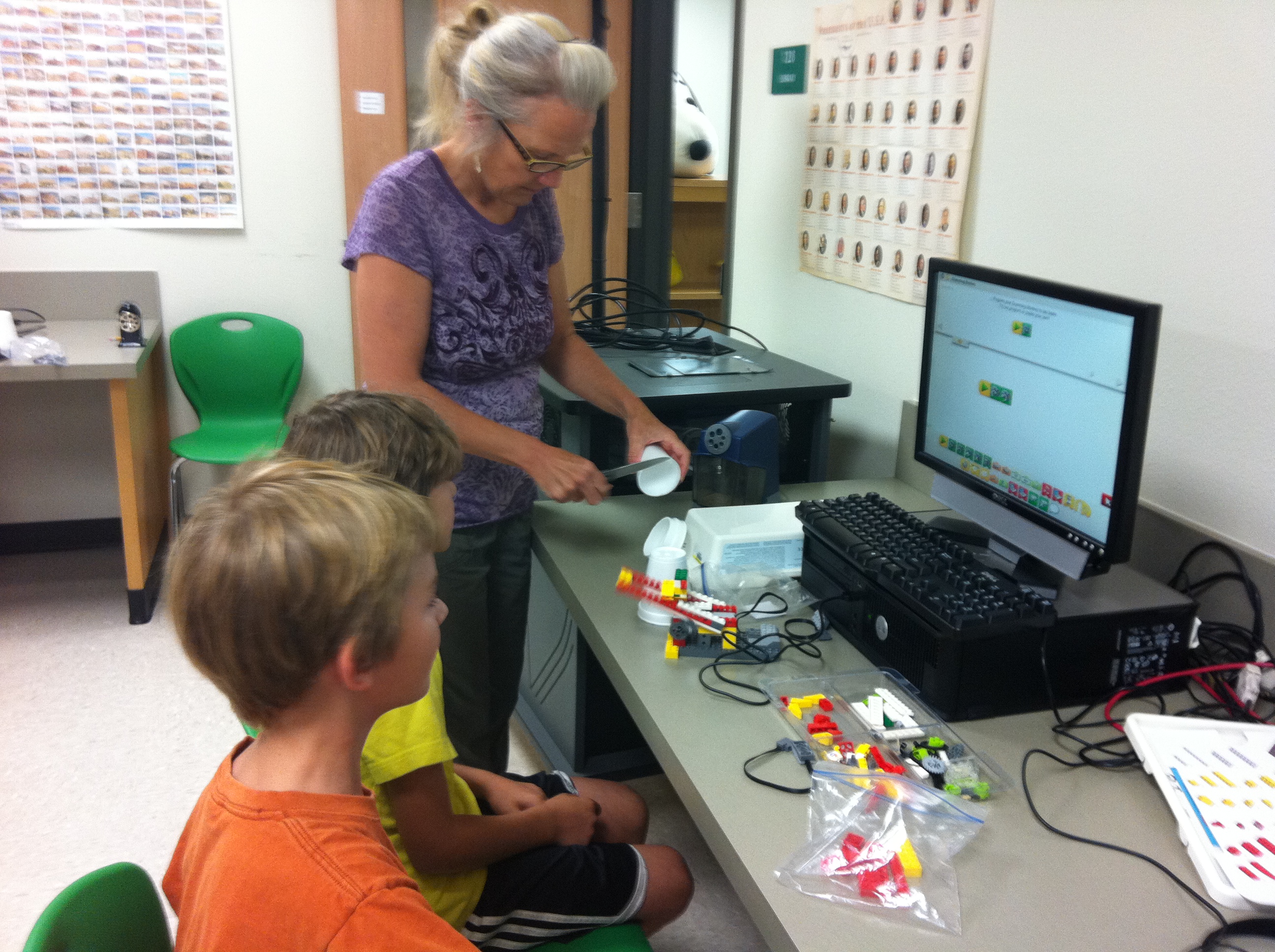
    7. Problem solving and failure with a voice: Robotics is a way to get kids motivated and you would be surprised at how these kits can fit your exiting curriculum. Lego released a writing curriculum this week that encourages creative writing and academic vocabulary development. The production that is created by the team gives students a voice by allowing them to showcase a robot to a wider audience. It is great to see so many students enjoying problem solving activities using robotics.  Dublin High School, and photos from Dublin Intermediate and Junior High students who are so excited to be part of the after school robotics club. We have 47 students participating weekly in an optional after school program. These students are having fun expanding in writing journals, collaborating, thinking and problem solving. . We learn from failure. Research on this topic: http://hbr.org/2011/04/strategies-for-learning-from-failure/ar/1

    8. Portfolios are a great way to showcase student work and online portfolios gives students a large voice that they can then take to a wider audience. This is a great way to give students a career voice. With project share, students have an Epsilen portfolio account that can allow all teachers to “showcase” a student production that they can then add to their existing portfolio.

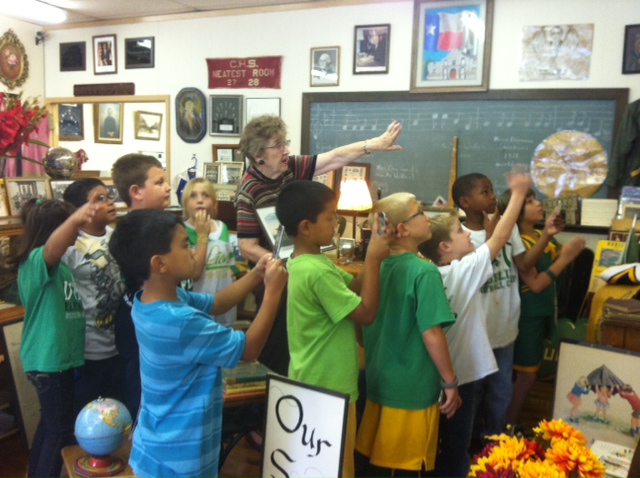
    It was fun taking students with their teacher, Mrs. Donna Lewis, to the Dublin Historical Museum recently.  Students really enjoyed learning about museum artifacts, conducting research, using their iPods to record photographs, and creating a movie to publish for a wider audience.  Learning really can be fun!

    Image

  • I Believe…

    • I will model life long learning, contribute and produce quality content, encourage critical thinking and questioning, motivate, interact, collect and analyze new information, collaborate across cultures, and assist students in becoming global thinkers. 
    • I strongly believe in challenging educational stakeholders and students to produce a better world by making connections, building relationships, and maintaining high expectations to foster a passion for learning. 
    • I believe all children, regardless of background, race or religion, can achieve greatness. I will value diversity, encourage creativity, and become an advocate for all students. 
    • I believe all stakeholders must foster the imagination and curiosity of all students and extend learning opportunities by providing real world applications and learning experiences in a fun, supportive, and engaging environment.

    Image


    Image


  • The Power of Texas’s Project Share

    I am amazed at how many K12 Texas institutions are still not utilizing Project Share as a course management system.  While there is still room for improvement, especially the need for a quality LMS app tool, Project Share is still a great idea and resource to use in a blended learning environment.  Project Share is continuing to improve its product, with new features being introduced this fall.

    Questions you may have regarding Project Share.

    How will Project Share help my students?  

    1. Resources From Top Reliable Sources:  Students can access primary sources from The New York Time’s Content Knowledge Repository dating back to the mid 1850s.  This is a powerful learning tool that can radically enhance courses and bring LMS to an entire new level.
    2. Collaborative Work Environments:  Project share allows for groups to collaboratively problem solve, share, and model 21st century collaborative work environments.
    3. ePortfolios:  Project Share gives students and teachers a ready made system to publish and showcase work, build resumes, and blog about learning content.

    Can parents access content?

    Parents, students, teachers, and interested community partners can access content and locate resources on the new Project Share website.

    It is time to move past the debate as to why do we need Project Share.  It is time to Think Global and Act Local and unite behind the program!  Take your complaints to the source and let’s fix a great idea.  I have found that Project Share, Epsilen, and developers are very open to ideas of improvement.  Texas, let’s show the world how true 21st century mobile learning can truly benefit a learning community.  


  • Thoughts on Instructional Design

    ImagePlanning is essential to the quality of instructional design and impacts the effectiveness of lesson delivery.  Understanding target market needs can often be overlooked, but it is very important to consider target market before thinking about instructional approaches.  

    Video technology is a powerful force and influential when pushing learning participants to consider other viewpoints.  Cooperative learning, video technology, emphasis on evaluating media, and challenge based learning can better engage students.  

    Giving students choices is also essential to student motivation and is an important component to instructional design.  Alternative assessment approaches that includes a portfolio piece is a research interest.  Standardized approaches to instructional design cannot be eliminated, but creative and alternative approaches to instructional design and assessment is needed.  

    Students are very interested in seeing work appreciated by the public at large.  Instructional design should give students a variety of choices, which includes many instructional technology components as well as creative and artistic components.