Tag: LMS

  • Designing eLearning Experiences

    What is your personal perspective on the best manner of designing instruction for online teaching and learning? What is your process? Does it match any existing methods? If so, which? How did you learn to design instruction? Does your process for designing instruction match your larger theoretical perspective? Where is it the same? Where does it diverge?

    Dewey (1904) stressed that teaching requires a technique,requiring training in psychological insight, theory, and experience. The idea mentioned above still  holds true today in both virtual and face to face instructional environments. Papert (1993) suggests that new technologies enhances learning with students actively participating as creators of personal media, supporting diverse intellectual thoughts and styles. As a contributor and student advocate towards a revolution within eLearning and maker movement, I emphasize the topic of voice within instructional design. How is voice utilized within instructional environments? Too often, instructional voice is a passive or copied MOOC or eLearning response. In fact, often eLearning professionals lack instructional voice and ignore the need of learners to receive valuable feedback within the community. Likewise, universities eLearning attempt to copy courses and include faculty whom are often unwilling to embrace the online movement. As a student, I have participated and paid for a poor online course. The teacher failed at communication and course work was copied within the blackboard environment. As a participant, I felt lost and alone. In fact, I could of recieved the same quality of instruction watching YouTube videos.  Within this attempt, faculty fail students as teachers and provide little to no communication.   Facilitation is needed within both face to face and eLearning environments.

    Teaching, in both face to face or virtually, is an art. Teachers must tailor course objectives and instruction, building an engaging and meaningful community. Anderson (2004) provides an excellent description of the role of a teacher within an online community.  Effective eLearning environments must include three critical pieces:  cognitive presence, social presence, and teaching presence.

    It is important to understand that learning to design online instruction requires participating within online environments as an instructor, designer, and student. Doing so provides perspective and produces a quality eLearning teacher, or artist. Failing to participate fully as an online student, teacher, and designer reduces skills sets mentioned above which produces a poor eLearning contributor and creator.  Active learning requires active participation.

    The process of instructional design within such environments is challenging as a designer as creation components require instructors to select technologies that embrace a wide variety of accessibility features. Learning artifacts, authentic reflection pieces, and feedback mechanisms should provide users with a choice of mediums. It is important for the learner to apply content to their real world situation, capture a learning artifact, and share reflections with a wider or global audience using media technologies. The instructor must facilitate this process and a copied course approach does not facilitate such an approach. The above process requires a strong life-long commitment by faculty to be a learner and will require institutions to provide instructional technology training to a faculty population who often fail to embrace change via eLearning platforms.  Perhaps, the time has come for many organizations to recognize that old approaches, although still valid, must be altered to embrace a deeper eLearning experience that students richly deserve.


    Anderson, T. (2004). Teaching in an online learning context. Theory and practice of online learning, 273.

    Dewey, J. (1904). THE RELATION OF THEORY TO PRACTICE IN EDUCATION» 1».

    Papert, S. (1993). The children’s machine: Rethinking school in the age of the computer. Basic Books.

  • Constructionism Approaches Within Canvas LMS

    Based on your experience putting your lesson into the Canvas LMS, what do you feel are the benefits of using such a structured space for teaching and learning? How well does the structure of an LMS fit with your theory of online learning?

    Creating a professional development spaces within a Canvas LMS supports my approach to online K12 STEM professional development. Canvas is a free LMS system that proves to be user friendly, integrates nicely with third party web tools, and includes excellent multimedia capabilities that are lacking in many other free LMS enviornments. Discussion tools can be used to create a social experience and allow for users to attach video feedback or embed external content and share experiences within a learning community in a very meaningful way. However, the space is only a tool and the content of the instructional activity itself, along with participants, and instructor encouragement must all be present for the lesson to be a productive and meaningful experience. The module component allows for clear organization. Pages offer customization approaches to allow for increased flexibility. The record and upload media feature within Canvas discussion tools will prove to be an effective tool to increase participant engagement. Collaboration tools to include Google Docs and Etherpad provide a layer of collaboration not found in many other LMS environments. Users can use Google Docs, for example, to create reflections or “artifacts”, to share with a larger community within Canvas. It is nice that Canvas works well with other media tools. Media used as a reflection tool provides the learner with the ability to produce a more meaningful perspective in which they can share within the online environment. However, Canvas does lack the embedding of social media tools, which I would find useful. I am embedding links and suggesting a community hashtag to utilize within the course to tap into social media components. The LMS can be utilized within a constructionism approach to online learning as it allows for connectedness. However, teacher presences along with clear directions and organization within the LMS must be present for the lesson within Canvas to be successful. Canvas LMS does have the ability within the learning environment to provide a means for learners to connect, share, and present alternative viewpoints. The ability for media to be incorporated as video to produce such collaboration is an added benefit to employing Canvas LMS. The following websites have assisted me in learning more about features available within Canvas.

    http://guides.instructure.com/

    https://github.com/instructure/canvas-lms/wiki

  • Building Online Learning Communities: Synchronous vs. Asynchronous Tools

    Synchronous (i.e. Connect) vs. asynchronous tools (Forums): Which is better at fostering online learning? Why? What are your reasons and evidence for this?

    Stodel, Thompson, & McDonald (2006) stress the importance of maintaining and modeling a “social and cognitive presence” within the online learning community. Results from research cited in the above study indicated that learners engaged in interactive activities focusing on synchronous activities set the stage for a deeper learning experience. Linear asynchronous activities lessened the desire of participants to engage in learning activities. Face to face video using Skype, Google Plus, Adobe Connect, or GoToMeeting activities provide an opportunity in which the learning communities can foster a deeper collaboration experience, building a highly social and interactive exchange of energy. Questioning, reflection, and activities to encourage dialogue deepen the learning experience when utilizing a synchronous approach. Instructors should rely less on the lecture format when using a synchronous tool.  Again, it is important to foster interaction and social dialogue, which is easily accomplished using synchronous technologies.

    Is there a place for asynchronous activities? The above study also found that a creative text dialogue used within the introduction discussion board using a poem improved the social experience within the learning community. It is important to note that advantages do exist using asynchronous tools to include flexibility and improved written communication techniques. Perhaps, asynchronous actives could embrace text based social media tools to improve the overall learning experience. Professional learning discussions are often highly engaging using social media collaboration tools such as Twitter and Today’s Meet. Searls (2012) encourages online learners to reach out using asynchronous tools along with social media can lessen the feeling of isolation.  Often instructors are absent from discussion tools, which leads to an isolated learning experience.

    A blended approach to online learning using a balanced mixture of synchronous and asynchronous tools is the best option to building a rich and interactive learning environment. Instructors must be present and model social engagement consistently and frequently synchronously and asynchronously. Including an organized schedule of expectations and timeline of synchronous and asynchronous tools provides structure to improve the overall effectiveness of a learning exchange.

    Searls, D. B. (2012). Ten simple rules for online learning. PLoS Computational Biology8(9), e1002631.

    Stodel, E. J., Thompson, T. L., & MacDonald, C. J. (2006). Learners’ perspectives on what is missing from online learning: Interpretations through the community of inquiry framework. The International Review of Research in Open and Distance Learning, 7(3).

    Wang, F., & Hannafin, M. J. (2005). Design-based research and technology-enhanced learning environments. Educational Technology Research and Development53(4), 5-23.

    http://academictech.doit.wisc.edu/blend/facilitate/communicate

  • Considering Online Course Delivery: A Graduate Learning Technology Student Perspective

    Why have we moved so many courses online?

    Mobile platforms provide flexibility to a growing global market of adults seeking to improve skill sets needed within a 21st century workforce. Cellular applications used to access online learning content, along with the deliver of MOOCS, offer students convenient approaches to learning online. Globalization combined with an emerging demand from a previously absent third world population within the post secondary market will continue to push for increased access to online learning. Improvements in communication technologies along with increased access in rural environments allow for new markets and platforms to fulfill an ever increasing demand to online education.

    Online learning platforms include the following choices to training and higher ed institutions.

    Canvas is a free, very sleek and is attractive to users.  It is a very user friendly, providing simplicity.  Social media can be integrated within the system, which is very appealing to students and instructors.

    Schoology is an excellent approach to online learning and offers many advantages to students to include a simple and collaborative user interface.  Did I mention that it is also FREE?  Mobile applications are limited with this feature.

    Moodle includes a great new mobile app platform and continues to offer access to quality LMS to a growing online learning population. Moodle’s layout and mobile features has greatly improved and continues offer quality LMS options  globally for FREE.

    Blackboard has upgraded services and is offering a free online course management system, CoursSites.  However, unlike Moodle you are limited to 5 courses per log in.

    As students, do you feel like online courses are as good as face-to-face courses?

    As a student, having an instructor, human, actively participating within the course is a must.  The relationship between a teacher and a student is the most important factor in determining success.  Online courses can be as good as face to face courses when the instructor encourages online dialogue and communication within the course environment.  Video face to face weekly meetings, along with a simple and organized approach to delivery can provide this option.  A true learning community must exist in either learning environment.  This is why MOOCS will not completely replace instructors as students need a quality learning experience.

    What are the major differences between online and FTF courses for you as a student?

    A major difference between online and FTF courses is the frequency of interaction within the learning community.  Again, a MOOC does not provide frequent quality dialogue.  Students must be more disciplined when participating in an online environment, questioning and seeking solutions.  It is easier to do so within a face to face environment.  Learning curves exist when trying a new LMS platform or when updates to existing platforms occur.  Instructors can mitigate these issues by posting help features within the course.

    Whether you have taught one or not, what do you think the differences are for the instructor? How do we know if the formats require different skills or result in different learning outcomes? Do we?

    Instructors should choose features and integrate files that work across mobile platforms.  In addition, providing recordings to assist students who may need to refer back to information during the course is helpful.  Learning curves are perhaps larger for instructors, as technologies and LMS platforms change constantly.  University and corporate institutions should consider providing support and training options regularly to share best practices within the organization.

    Image

    Some links that I found  interesting regarding the growth of online learning are located below.

    http://www.uis.unesco.org/education/Pages/international-student-flow-viz.aspx

    http://edition.cnn.com/2013/06/21/business/opinion-koller-education-petersburg-forum/

    http://harvardmagazine.com/2013/12/harvard-mit-online-education-views-changing


  • Considering How To Improve Virtual Learning

    Connecting is key to experiencing positive LMS experiences.  Instructional designers must consistently evaluate content.  Often faculty lack time to revisit learning approaches, but improving the quality of online learning platforms is crucial to growing post-secondary environments.  LMS must be systemic and continually evaluated.  Far too many virtual courses develop a learning repository for students and courses are not viewed as unique experiences.  This often leads to feelings of detachment from both the learner and instructor.  Content may become dated.  Instruction often lacks meaning.  Building stronger connections requires both collaboration and evaluation of instructional approaches.   Faculty often do not revise courses in LMS environments.  Approaches to holistic and consistent instructional design is needed for all learning environments, virtual and face to face.

    The Kemp Model

    Image

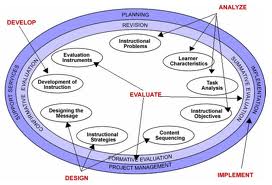
    The Kemp Model is one approach to revising content within the learning environment.   The designer is free to begin with any Kemp Model element and instructors can be flexible as they do not have to present elements in any particular order.  Multidisciplinary approaches must be considered by faculty.  How can we reliably and consistently evaluate online learning environments?  How do we keep the element of creativity as we apply standardized evaluation techniques?  Models are tested.  Theories explain the whys surrounding learning outcomes and experiences related to an instructional model.

    ARCS Motivational Design

    The ARCS model appeals to me as it lends itself to a strong sense of community and student motivation.  Using experiences, visuals,  relevance, and strong collaboration exercises provide meaning. Satisfaction and confidence are two great elements for faculty to consider measuring.  The ability for users to form deeper short term and long term relationships is measurable.

    Image