Tag: STEAM

  • Reflective Teaching ~ Exploring My Makerspace Literacy Research Approaches and Classroom Practice

    Currently, I teach six graduate education courses at Sul Ross State University, which is a small rural university serving 898 graduate students and a little over 2,000 undergraduate students. The institution is a Hispanic serving institution, serving low income students (Jenkins, et al., 2017). I am working with many rural schools in the Big Bend area to include Presidio ISD. Presidio ISD is a STEM school, and serves a population of 1,350 students to include demographics of 96.6 % Hispanic students and 93.4% economically disadvantaged students (2015). Presdio ISD is located on the Rio Grande river, located on the Texas-Mexican border. In addition, I am working with Maathon ISD, which is a rural district serving over 70 students to include a demographic population of 67 % Hispanics and 87 % economically disadvantaged students (2015). I am also working with several districts in the Trans-Pecos area.

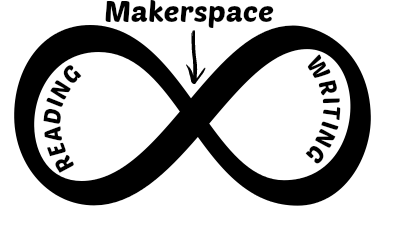
    My learning goals this academic year is to grow as an educator and continue improving my Ph.D. research initiatives at the University of North Texas investigating makerspace literacy environments that centers around a project-based learning 4 career STEAM model targeting elementary and middle school programs.  My knowledge regarding the reading process has definitely changed and improved this semester. Perhaps the most significant change includes reevaluating my approach to really center on balanced literacy approaches that really think about transactional theory in action during professional development and instructional design approaches. Transactional theory centers on “how readers respond to the books that engage them and how these experiences can be enacted in classrooms” (Galda, 2013, p. 6). Transactional theory is rooted in Vygotsky’s social constructivism and principles of language and cognition, “which centers of teaching reading and writing highlighting creation of environments and activities in which students are motivated and encouraged to draw on their own resources to make live meanings” (Rosenblatt, 2013, p. 148).
    infinity_1_orig

    What will I eliminate in the future? I will eliminate some of the STEM quantitative measures I have used in the past. These instruments were only used to show interest and attitude toward STEM and never measured the impact on the overall impact of literacy. Previously, I would give this instrument before and after a STEM makerspace camp or at the beginning of a semester and at the end of a semester to gauge interest. I utilized the makerspace project-based learning model and only measured the impact of interest. The model did incorporate reading prior to the makerspace PBL and a written reflection after the experience. The pre and posttest utilized in two published studies found statistically significant findings but failed to measure the impact on reading and literacy.  The learner would take the STEM Semantic pre-test, read text from their content area, participate in a KWLH 21st century learning activity, participate in a makerspace project-based learning activity using challenge cards mapped to curriculum, and reflect via writing about the experience. At the end, learners would take another post-test, the STEM Semantic survey. I have not really considered the empirical design approaches to include journaling during the entire makerspace process and/or video recordings to include in portfolios in research approaches. In the past, I have used only quantitative measures to gauge student or teacher interest and confidence levels pre and post over a period of time. While the instruments we used at the University of North Texas are widely accepted as strong and valid instruments, I now realize that a mixed method approach to include journaling throughout the experience and video interviews and reflections would add further depth to capture the impact of the STEAM makerspace challenge cards before and after literacy events. In addition, I feel this would really add to the field of sociolinguistic issues discussed this semester. I now have a stronger understanding on how to leverage native language and family cultural heritages in the makerspace model to not only improve literacy in English Language Learners but also to value the funds of knowledge to this process.

    How can this approach help increase literacy opportunities for English Language Learners? First, I need to strengthen the collaborative dialogue, which I feel is strong in the KWLH activity. However, I can improve the scaffolding of my model to include previewing a picture book, vocabulary discussion, incorporating a story map, repeat reading of the story, compete the KWHL activity, and then encourage discourse after the makerspace activity. In addition, I can encourage video procedures and or reflections throughout the makerspace process. This will provide a visualization component that others may find beneficial and highlight the impact of the activity. Repeating readings can be used to measure fluency. The makerspace PBL activity using the challenge card concept could also include visualization to incorporate sociolinguistics highlighted in this course.

    Tan, Barton, & Schenkel (2018) describe the impact of “meaningful and prolonged engagement toward focused complex projects through making experiences and found that children’s rich funds of knowledge anchored in children’s existing social networks provide community enthnography as a pedagogical approach (p. 77). Bringing in the “community wisdom” through makerspace activities brought about rich conversations that can really leverage experiences connected to curriculum in their own community (Tan, Barton, & Schenkel, 2018, p. 81). Range & Schmidt (2014) highlight the importance of schools and community organizations to tap into prior knowledge in makerspace activities and suggest that “students drive the process of designing projects and soliciting makerspace community for help” (p. 8). While I agree this is true, I still think many students need facilitation of such projects through a focus that may connect to core curriculum content, showing that topics can be extended to real world scenarios relevant to their community.

    In conclusion, this course has helped me to really improve my understanding on how to better design literacy instructional design approaches to incorporate a large focus that centers on the transactions of the reader, text, language, culture, authentic making design process, writing, and reflection. I hope to revamp my approaches to really center on how such creative processes might not only engage interest in STEM but also build to improve cognition approaches toward multiple literacies in a mobile makerspace research environment that investigates reader response theory, or transactional theory

    Galda, L. g. (2013). Learning From Children Reading Books: Transactional Theory and the Teaching of Literature. Journal Of Children’s Literature, 39(2), 5-13.

    Jenkins, R. W., Stedman, S. W., Teusher, D. D., DeLaGarza, H. R., Acosta, A., Anwar, S. J., Paredes, R. A. (2017). Texas Public Higher Education Almanac.

    Marathon ISD, (2015) Retrieved April 13, 2018 from https://schools.texastribune.org/districts/marathon-isd/marathon-isd/.

    Presidio ISD. (2015). Retrieved April 13, 2018, from https://schools.texastribune.org/districts/presidio-isd/.

    Range, E., & Schmidt, J. (2014). Explore, plan, create: Developing a makerspace for your school community. School Library Monthly, 30(7), 8-10.

    Rosenblatt, L. Transactional theory of reading and writing. In J.B. Cobb, & M. K. Kallus (Eds.), Historical, Theoretical, and Sociological Foundations of Reading in the United States (pp. 13-66). Boston, MA: Pearson.

    Tan, E., Barton, A. C., & Schenkel, K. (2018). Equity and the Maker Movement. Science and Children, 55(7), 76-81.


  • Round as a Tortilla Makerspace STEAM Literacy Event

    Moll, Amanti, Neff, & Gonzalez (2011) describes the importance of education programs leveraging a child’s fund of knowledge through connecting with families and involving a holistic approach toward learning activities and learning environments. Makerspaces can serve as a quality environment to facilitate activities to incorporate balanced literacy approaches to meet the needs of diverse learners. Range & Schmidt (2014) suggests “successful makerspaces, particularly in education environments, balance practicality with creativity and collaboration to serve the needs of the school community” (p. 8). Tan, Barton, & Schnekel (2018) highlight that “children’s funds of knowledge were recruited by engaging them in community ethnography, which informs of the making design process” (p. 77) via a makerspace environment. The purpose of this activity is to align a purposeful makerspace activity to topics explored in Pre-K and kindergarten using the book by Thong & Parra (2015), Round as a Tortilla.


    Repeated Reading Strategy

    Day One

    1. The teacher will introduce the, Round is a Tortilla, to their students. The teacher will show the front cover, back cover and conduct a picture walk.  Remember to read the story enthusiastically, and with expression.
    2. After reading, ask why questions to allow time for students to make inferences and to measure understanding of story events.
    3. Begin the a KWHL: What do we know? What do we want to know? How will we find out? What have we learned? How will we find out?

    Send home a Round as  Tortillia Makespace STEAM Event letter to invite parents to the school library and to participate in making items from the story. Include 4 challenge card ideas in the letter with a link to the video. Invite the makerspace community. Your librarian should be able to help you facilitate this process.

    Day Two

    The teacher will conduct the second read-aloud to enrich reading comprehension and provide further engagement opportunities through a book talk, and highlight vocabulary.

    1. Add more frequent questions.
    2. Ask children questions to think beyond the story with completing a KWHL, What have we learned?
    3. Introduce 4 STEAM Makerspace Challenge Cards and Makerspace activities. Here are some ideas. Encourage students to make their own challenge card but remind students that cards should connect to elements found in the story.
      1. Journalist: Be a storyteller and make a story about shapes in your community.
      2. Scientist: Be a scientist and investigate the process of making masa and round tortillas. Be a computer scientist: Make a game with squares and other shapes.
      3. Artist: Make a weave of shapes to use as a rectangular flag as represented in the story. Make an oval necklace.
      4. Engineer: Engineer a sail for a boat that you make.

    Day Three:  Makerspace STEAM event in the library. Students will make items that represent elements in the story with their parents and makerspace community.

    Repeat the reading of the story. After the activity, ask the children, What have you learned?

    This activity connects to Moll’s ideas of knowledge as it involves the child’s entire community in the literacy process. Children can learn how their culture connects to classroom topics through the art of making. Elders can help children learn how to weave, code, build, and apply STEAM principals through everyday activities.

  • Don’t Stop Believing…Leading Change Through ACTION

    Today I had the privilege of spending the entire day with Eric Sheninger. He encouraged us to consider who will tell our story if we don’t. What will they say?

    That was an important and scary question for me to consider right now. I am gun shy as my major professor stated. My story is an amazing story and I have been blessed to meet and work with some amazing educators. This is my perspective from past experiences. I have seen kids make a very large impact in the world . I have been so blessed to identify my passions early on and to have had a creator put special opportunities in my path along with some amazing kids, teachers, and leaders.

    Assisting the community of Dublin, Texas with  Dr. Shaun Barnett and his wife Keri Barnett with a 1:1 K12 technology initiative in 2010, I became a leader. I am grateful to both of them for their leadership.  I believe this was the 2nd 1:1 K12 initiative in the state of Texas. Serving as the district instructional technologist and grant coordinator and later under a different leader a technology coordinator, I became a connected educator. I found myself working and leading the state in, dare I say the word, Project Share (the state’s first attempt for a connected Learning Management system) with Ms. Barnett. At that time, I had no one really in the area or Texas to connect with or to assist me. We brought in Alan November and Apple to assist in training.  What did I do? I joined a PhD program to connect with the top scholars of the world and began using social media to include Project Share, LinkedIn, Twitter, and Facebook. I  located people to assist me in understanding how to connect others to content. I became a passionate curator, creator, researcher, publisher, and scholar and feel as if I was blessed to oversee some amazing transformations. No one really understood what I was doing, but now I believe we planted a seed for not just a rural community, but for an entire global movement.

    Project Share: It didn’t work out, but the concept was right on. The ability for all students in Texas to have a digital portfolio via an LMS in which stakeholders could communicate and introduce blended learning was futuristic. I submitted a proposal and was surprised when we were selected to serve on a panel at the first SXSWedu conference. Yes, the LMS platform was flawed, Epsilen, but the IDEA of sharing was truly noble and ahead of it’s time. However, I found change slower than expected and a lack of understanding on the concept of connected learning. In fact, at the end of the experience after hours of free assistance from me to the Epsilen team, my participation in focus groups, and a public push for improved LMS features and training ,  I  found that I had lost my ability to even post or share with a wider network within Project Share. What did I do? I turned to other tools like Canvas and continued my passion to assist in helping others see the power of open source and communication.

    Student Voice: I remember introducing the concept of video creation with Samuel Parsi from Apple in a Challenge Based Learning PD. From that students began creating video and we were invited to lead change via a Ignite session in Austin in 2012 in the Digital Square. I remember taking students to TCEA 2012 in Austin in which my friends Randy Rogers, Dwight Goodwin, Mark Hooker, and Scott Floyd invited my students to participate in an Ignite session on their cause to TAKE 5: 5 Ways to Change Your Community and their efforts to QR code their 5 small museums. We used Google Maps to track our cause, which became eventually a Save Dublin campaign, #saveddp. Their efforts to save their rural town through digital curation left a huge impact. Mark invited our students to the first TED student event and we saw our first 3D printer. That led to a NASA STEAM camp program, which at that time and to my knowledge was the first STEAM camp program in Texas. 

    Makered and STEAM: No one in 2012 understood the maker movement. I am grateful to Whitney and Tom Kilgore who invited me to be to host some of the first #txeduchat events, all focused on STEAM and makered ideas. Those ideas assisted us last year in leading the entire world with the first student NASA launch parties . We also hosted a Google Hangout to reflect on STEAM programs.

    From this experience, I was able to take ideas to the Kennedy Space Center. This month I found myself leading makercamp at the Dallas Perot Museum and again saw kids amazed to create 3D objects for 3D printing for the first time in the Perot Learning Lab. During their makerspace, kids were amazed and so excited to see everyone enjoying their reflections.

    I was invited to Washington DC last October to lead a social media event at a NASA clean room facility. What did I do? I didn’t shut out the students and take it in just for myself. I brought the kids in, thankfully with Mr. Chris Underwood and Bea Price. They agreed to Skype with me all day and I believe that was the first time at a NASA press conference that Skype was used  during public questioning. We had 5th graders asking tough questions to some of the top heliophysics experts of the world.

    Even though I have had been afforded all of these opportunities, I found myself during this entire time wondering if I could continue the charge. It is hard to be a bright light within an institution and at times hard to overcome obstacles, barriers, fear, efforts to control innovative change. It is hard to remain positive. Change is difficult . Managing my time and focus had become difficult along with maintaining a belief that I could be positive and actually continue in the public education sector.

    This spring I had many opportunities to move to the private sector. I have had some leaders tell me “Your too bright to be in public education.” “Jennifer, you need to be at a university.” “There is no future in public education, everything is moving to charter and online options because the system is broken.”

    I say to these naysayers, I BELIEVE in everyone’s right to an equal opportunity and the spirit of public education. I BELIEVE in YOU. I BELIEVE in our CHILDREN. I AM GRATEFUL  and WE WILL SUCCEED.

    Focus on Positive

  • My Personal Learning Theory Experiences: Taking it to the next level.

    Feedback provided to me was very positive and constructive. During this process, I completely changed my theory of personal learning, growing as a student and advocate of improving instructional approaches. As pointed out in my paper, “The “maker movement emphasizes learning through direct experiences, hands-on projects, inventions, and is based on a constructionist learning theory even if members and advocates of the movement are unaware of the theory” (Stager, 2013). As a member and advocate of the maker movement, I realize that the above statement summarizes my personal approach to learning theory. All constructionists embrace constructivism. However, constructionism approaches extend to include a larger social element, highlighting the importance of creation via learning artifacts within an extended community. After improving my understanding of constructionism approaches, I revamped my theory of personal learning and located many articles and studies to learn more about constructionism research approaches. Feedback stressed what I already knew to be an issue, proofing. Considering that I revamped my theory of personal learning completely, I recognize that time spent towards proofing would improve the overall quality of my product. However, instructors also complimented me on the overall paper, which really surprised me and has motivated me to continue and press on. Task two has led me to continue my research towards constructionism approaches, as I have located over 25 articles and research studies surrounding constructionism studies. I have begun condensing my paper. In addition, I plan to include a wider perspective to include research giants of constructivists and constructionism, instead of only emphasizing Piaget and Papert. Also, it was suggested that I should quote the source of important contributions to the constructivist and constructionism field instead of quoting from articles reviewed. For example, I quoted an article that mentioned John Dewey’s personal theory of learning. I have now read John Dewey’s own writings and contributions, which provides legitimacy. Our final major task towards completing CECS 6100 includes creating a research proposal. I plan on utilizing materials from my experiences in CECS 6100 to conduct a study that focuses on constructionism approaches with teachers to compare STEAM (science, technology, engineering, the arts, and mathematics) professional development delivered via a MOOC and face to face. Materials I am developing are very relevant to my real world professional experiences at this time.

    ImageImage


    Stager, G. S. (2013). Papert’s Prison Fab Lab : Implications for the maker movement and education design, 487–490.

  • Digital Fabrication (DigiFab) Technology as an Instructional Tool in K-12 Professional Development

    A course was designed for current K-12 teachers and instructional technologists recently as part of our PhD research towards our personal learning theory. With modification, this course could easily translate to instruction for pre-service teachers.

    The purpose of the course was to provide professional development (PD) training regarding DigiFab technology and potential instructional uses for quick and efficient implementation.

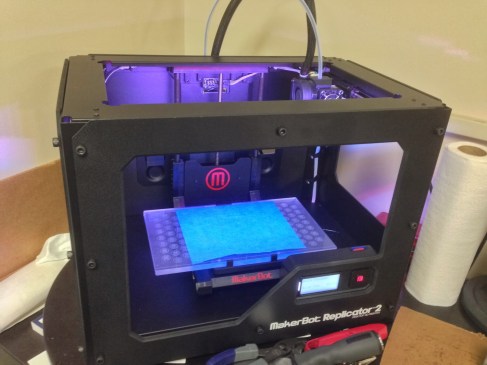
    The following problem was explained by my partner Jared Vanscoder and I. A resurgence of the constructivist approaches to teaching and learning has created a demand for a solution that requires little knowledge of manufacturing processes, aids visualization through tangible representation, and speeds prototyping. Digital fabrication technologies, such as 3D printing, are garnering much attention as they afford users to simply create tangible artifacts from digital model files. This capability is enticing as an tool for teaching and learning in K-12. Given the newness of this technology, very few K-12 instructors (or even instructional technologists) are aware of how these technologies can increase engagement and instructional impact on learners.

    The format of our course is designed as stand-alone instruction to be delivered in two separate formats: face to face (F2F) and online. The option of hybrid (components being delivered both F2F and online) should also be considered.

    How hard is it to develop a research method that both matches your theory and created curriculum?

    The activity allows learners to create order or reorganize information to construct new meaning. Learners construct knowledge, as a builder would begin building a structure. Fabrication technologies facilitate concepts of abstraction, allowing the learner to build or fabricate an actual object or model. It was not hard to match my personallearning theory to fabrication curriculum. After all, fabrication does lend itself to modeling and objects created with such a technology provide for a more meaningful approach to learning. Allowing participants to choose a “real world” scenario or object to reconstruct also fosters an active learning event, which provides further depth and richness in cognitive presence.

    What was simple and what was difficult?

    Creating an online instructional PD approach via problem based learning instructional design model within an e-learning context proved to be challenging. However, Jared and I are committed to being pioneers in the field of Learning Technologies and Cognitive Systems met challenges head on and worked to overcome. The overall product is very strong, with instructional goals met. However, time spent to accomplish learning goals online proves to be more intensive then a face-to-face environment. The overall learning potential I feel is greater in an online e-learning format as it forces the learner to seek solutions and not rely as heavily on an actual face to face community of learners. We suggested a reflection piece of the assessment component. Motivating teachers to complete a reflection at the end of the assessment piece may prove to be challenging. In addition, not seeing a 3D printer and only sending an STL file to post in a blog or learning management system may not be as effective as actually having access to a 3D printed product. Equitable access may prove to be a limitation within the online learning environment for fabrication PD approaches. I feel this activity challenged both Jared and I to think outside the box. As two educators and online students, we understand difficulties presented within the e-learning environment. However, the benefits of the e-Learning activity far outweigh disadvantages. Teachers are exposed to the very learning theory and instructional design methods proven to provide a rich learning experience using learning technologies that foster abstract thinking or cognitive development. Overall, I am very proud of our product. Hopefully, we can test our approach in a qualitative case study.Image

  • #TXEDUCHAT STEM and STEAM Collaboration Sun. Sept. 29, 8-9 PM

    Join me this Sunday as we discuss STEM and STEAM initiatives on Twitter at #TXEDUCHAT. Non-Texas residents, we want to hear from you! Let us know how you are incorporating STEM in your state. http://lnkd.in/bkU7tWY

  • Renew, Reuse, Recycle with NASA’s Multiscale Magnetosphere Mission using Fabrication Printing

    STEAM (Science, Technology, Engineering, the Arts/Agriculture, and Mathematics) after school programs serve as a fantastic tool to generate interest and to think about how the core sciences integrate nicely with liberal arts studies to solve real world problem scenarios.  STEAM camps provide students with a fun learning approach in which topics are explored, researched, and presented to promote true differentiated learning. Dublin Intermediate and Junior High hosted a second annual STEAM camp  last month.  Dublin is a rural community located in central Texas, and is working to learn more about solar energy with NASA education’s Multiscale Magentosphere team, the Perot Museum, Tarleton State University, and the University of North Texas.  Students were exposed to vocabulary concepts related to NASA’s Magnetosphere Mission and reflected using the arts.  Vocabulary approaches were emphasized the first day of STEAM camp and  included the following stations:  Technology Games for Vocabulary, the Art of Vocabulary, MMS Spacecraft  Vocabulary Game, and Creating an iBook Glossary.  Integration Tools that were utilized during the first building block included the following.

    Spelling City

    ePals

    Flash Card Stash

    Keynote

    Students were exposed to a variety of science integration lessons were students learned about magnetic force and the sun.  Rockets were built and launched within a space crew.  Professors, researchers, the public librarian, TX Dot engineers, artists, and NASA engineers were brought in to meet with students daily.  In fact, students had the privilege to meet Laurence Gartel, the Father of Digital Art.  Students built a solar oven, roasted s’mores, and reflected by creating magnetic art using iPods.

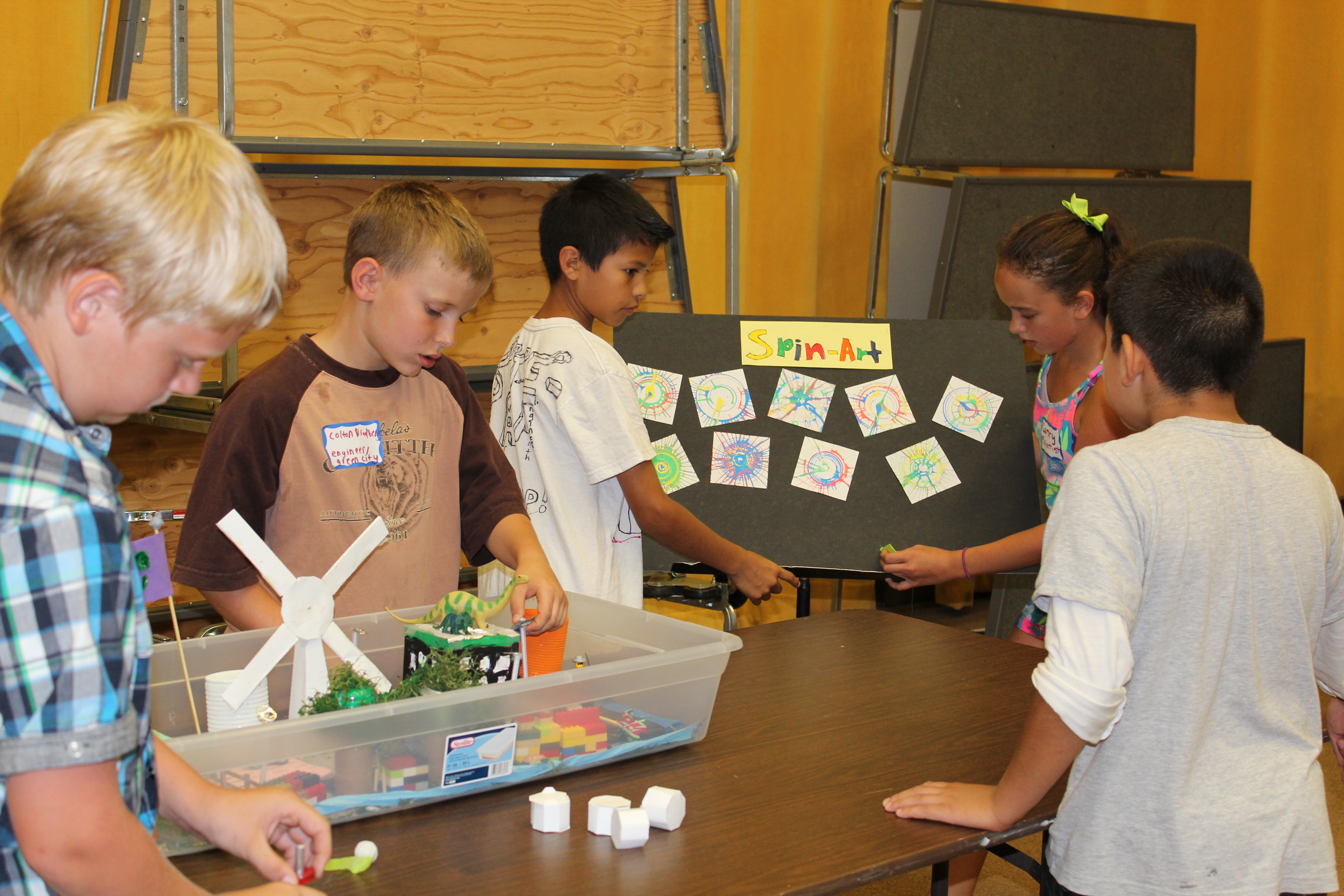
    Career guest speakers were brought in virtually and in person throughout the camp experience.  Guest speakers shared how topics like magnetic force, measurement, force and motion, green economics, and the creative arts connect to their real professional lives.  Students were exposed to TED’s William Kamkwamba to learn about the power of thought, action, and belief in reusing items in existence to build a useful object to help a community.  Students were then exposed to Make To Learn resources and Fab Lab and were challenged to build a windmill.  Young engineers built Lego NXT robots during STEAM camp.  Crews were challenged to build a green city using either recycled trash or Legos.  Most crews chose to use recycled trash and Fab Lab to build a green city.  STEAM camp participants were fortunate to have the opportunity to visit the Perot Museum to learn more about renewable energy and participated in Biofarming for Fuel.  As a final exercise, students replicated NASA’s Transmedia MMS labs to build a scaled version of NASA’s MMS spacecraft.  Tarleton State University hosted a space lounge exhibit at the Fine Arts Center in late June were crews led a student museum exhibit and served the role of an artist, engineer, scientist, or journalist to teach the public at large about renewable energy, magnetic force, and NASA’s MMS 2014 mission.  The experience was shared at an academic research conference exchange and at the International Society of Technology Education 2013 conference in San Antonio in June.  A special thank you to Tarleton State University, the University of North Texas, the Perot Museum, and NASA for giving students this once in a lifetime experience.  Image

  • Sun + Technology + Earth + Art + MMS = NASA Sun Earth Day Celebration

    Students that participated in Dublin/RYSS’s Joint Art Workshop in the spring of 2012 utilized solar weather data images provided by NASA to produce digital art that was used for the backdrop during NASA Edge’s press conference held to celebrate Sun Earth Day 2013.  Tom Chamber’s students attending RYSS and DISD students researched academic vocabulary related to space weather and the sun to develop a working knowledge and purpose surrounding the mission.  Students from RYSS traveled to DISD to teach students how to utilize GIMP and utilize NASA data images to create a personal reflection surrounding the mission.

    Dublin Independent School District is located in central rural Texas and is beginning its second year studying about NASA’s MMS (Magnetospheric Multiscale (MMS) mission).  Students are learning about solar weather, earth’s magnetosphere, and magnetic force.  Students participating in DISD’s STEAM (Science, Technology, Engineering, the Arts, and Mathematics, 2012 camp experienced joint PD with teachers learning 21st Century skills and STEAM career opportunities.

    STEAM camp produced much excitement in Dublin during the fall of 2012, and students formed a robotics club to focus on the engineering components.  Students attended their first robotics competition, hosted a MARS party to teach skills to a neighboring district, and participated in PIE (partners in education) showcase during the spring of 2013.

    DISD will host another STEAM camp during June of 2013 to learn more about how the sun can be utilized as a renewable energy source.  Students in Texas were very excited to see their work showcased yesterday.

    NASA’s MMS Educational Resources 

    Creativity Tools

    ISTE NASA MMS Challenge

    STEAM Resources

    NASA EDGE Sun Earth Day 

    Dublin ISD/RYSS NASA Edge Webcast

  • Exploring MUVEs in K12 Environments

    Working with an atmosphere of high stakes testing, time needed to direct students towards instructional engaging students using MUVE (Multi-User Virtual Environments) is limited.  How can leaders promote the use of MUVE in an after school program?  Would such a program be engaging?  Would students gain valuable knowledge participating in after school instructional MUVEs?

    MUVE’s can foster collaboration and learning communities.  Jones & Warren’s (2011) study demonstrates tough challenges facing K12 teachers interested in pursing MUVE integration approaches, with only one of nine research participants able to move forward to utilize a MUVE with students.  Little research can be found to support integration of MUVEs in the K12 classroom, and there is a strong need to show that such environments improve academic yearly progress (p. 6).

    Sardone & Devlin‐Scherer (2008) point out that developers often fail to consider learning processes and first consider the user not the learning process.  Further research on learning outcomes is needed in this area.  Students do spend a lot of time after school accessing participating in a MUVEs.  Could developers and ed tech corporations leverage games and MUVEs to produce a more knowledgable society by considering first the learning process during design?   How can we leverage after school K12 time using MUVE’s to enrich learning experiences?  The market exists.   Perhaps a generation of STEAM learning designers, scientists, programmers and digital artists are needed.  It would be very interesting to have students recreate history like the example here, Teachers Discovering History As Historians.

    Are you interested in virtual gaming in an after school tutorial program?  Here are some K12 resources.

    Multi User Environment Educational Resources

    MindCraft Educational Resources

    Jones, G. & Warren, S. J. (2011), ‘Issues and Concerns of K-12 Educators on 3-D Multi-User Virtual Environments in Formal Classroom Settings.’, IJGCMS 3 (1) , 1-12 .

    Sardone, N. B., & Devlin‐Scherer, R. (2008). Teacher candidates’ views of a multi‐user virtual environment (MUVE). Technology, Pedagogy and Education, 17(1), 41–51. doi:10.1080/14759390701847484

  • STEAM…..Teaching to Foster Creativity……

    Digital technology is driving users to rethink how to create by introducing students to new styles, modes, and audiences. Students can now engage as creators, producers, contributors, users and evaluators in the social and professional environment. Tillander (2011) encourages art educators to not ignore the opportunities available, which is fostering a cultural revolution. Giving students the opportunity to contribute thoughts or reflections from research in a social context gives meaning to content. Teachers can now expose students to a variety of perspectives, which fosters critical thinking using Bloom’s Digital Taxonomy (p. 44-45). Allison (2012) encourages teachers to consider the following questions when evaluating the creative potential of existing curriculum and materials. “Is it possible for students to develop than one idea in this context? Is it possible for students to develop more than one type of idea in this context? Do students have the content knowledge necessary to successfully generate creative ideas? Do students have sufficient time and information to think through their creative ideas and communicate them” (p. 55). How do we teach creativity? As we attempt to understand issues and redesign instructional approaches, encouraging the arts across PK-16 would be an excellent start towards answering that question.

    Celebrating STEAM Resources

    Tillander, M. (2011). Creativity, technology, art, and pedagogical practices. Art Education, 64(1), 40-46. Retrieved from http://search.proquest.com/docview/847386915?accountid=7113 Allison, A. M. (2012).

    Teaching for creativity. The Science Teacher, 79(5), 54-56. Retrieved from http://search.proquest.com/docview/1023451500?accountid=7113