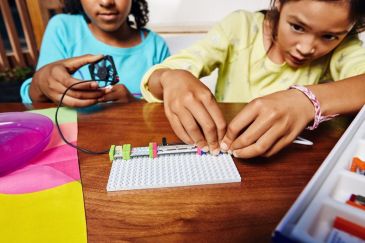
 Social constructionism “relies on the centrality of language to mediate what people come to understand about their lived experiences” (Avermann, 2011, p. 205). Constructionist environments support “active learning” approaches in which learners are engaged in building their own public objects or artifacts. Active learning emphasizes cognitive processes occurring during the actual construction of the object. The public nature of the final object or artifact is also understood to be important (Beynon & Roe, 2004). The “maker movement emphasizes learning through direct experiences, hands-on projects, inventions, and is based on a constructionist learning theory even if members and advocates of the movement are unaware of the theory” (Stager, 2013). Papert (2000) advocates that Piaget’s belief of all learning takes place in discovery is accurate. However, Papert extends this idea to suggest that setting learners “to the task of re-empowering the ideas of being learned is also a step toward re-empowering the idea of learning by discovery” (p. 723). Papert (1999) underscores the importance of Piaget’s theory of constructivism and the nature of knowledge. Challengers of Piaget’s constructivism often refer to experiments demonstrating knowledge acquired by infants. However, Papert stresses “Piaget as a giant in the field of cognitive theory, the difference between what a baby brings and what the adult has is so immense that the new discoveries do not significantly reduce the gap but only increase the mystery” (Papert, 1999, p. 105). Papert’s Knowledge Machine” introduced the world to a new theory of learning, constructionism, which “synthesized revised insights into human development, systems theory (cybernetics) and how we think about learning (epistemology)” (Maser, 2013). Technology based modeling and methods of teaching with technologies deliver alternative methods to teaching, providing learners with choices that engage the learner in an improved learning experience (Burbaite, Stuikys, & Damasevicius, 2013). While at MIT, Papert developed Logo, designed to introduce children to programing and robotics as early as 4th grade. Children received instant feedback from a real and physical response to their creation using technology. Papert envisioned robotics as being extremely influential to children at a young age. Learners perform higher when engaged in an activity that is meaningful to them, and robotics along with programing languages encourages curiosity and experimentation beyond the actual syntax (Pierce, 2013). Papert led many research projects to study the effects of constructionist theories with at risk populations and in high-risk environments. These projects attempted to build an alternative approach to the learning environment. Despite obstacles, students proved to be successful. Experiences from Papert’s work towards building a community of learning centered on constructionism continues to guide the future design of learning environments (Stager, 2013).
Constructionists follow constructivist theory, believing that children through personal experiences construct and reconstruct knowledge. Both viewpoints endorse the objective to push learners to consider a variety of perspectives and viewpoints within the world. Doing so advances cognitive abilities of learners by provoking learners to consider and expand a deeper understanding about themselves within their environments. However, constructionism emphasizes active and situational learning in which connectedness with the environment is “key to learning” (Acerman, 2001). Unlike constructivists, constructionists stress the importance of a learner to use their ideas to attempt to solve a real problem coming from a personal perspective, thus making the environment meaningful. Papert stresses that active and situational experience provides idea power or being one with what you are doing. Constructionism is “powerful in its use, powerful in its connections, powerful in its roots and its fit with personal identify” (Papert, 2000). Noss and Clayston (2015) provide characteristics of constructionism agenda, which is beneficial toward beginning to address the many misunderstandings and issues presenting the framework of constructionism. Characteristics include “modeling, accessibility to digital technologies, layering problem solving activities, designing socially relevant learning, and “knowledge made visible by being represented in a language with which learners can express themselves” (Noss & Clayston, 2015, p 287).
Makerspace environments can lend themselves to social constructionism following Noss & Clayston’s (2015) characteristics as learning can be designed to socially engage our youth through relevant problem solving activities or challenges. Products and the making process allow learners to socially share their perspectives using language and cultural experiences native to their background. These are the types of activities I have been designing. I have been working and traveling for the last week attempting to take ideas to a mobile makerspace outreach bus to expand research from my previous makerspace projects. .
This new project seeks to build upon previous NASA MMS research conducted by me through past funding and research that incorporated NASA’s MMS Makerspace Mobile Training Outreach programs, NASA MMS STEAM camp programs, the NASA MMS Challenge, MMS Transmedia book, and MMS Educators Guide. Previous programs provided global professional development for the last four years at ISTE, SITE, Makerspace, ASCD, and TCEA. The mobile STEAM makerspace outreach program developed last year seeks to expand NASA’s MMS Challenge incorporated at NASA’s MMS Launch Event in March 2015 at the Kennedy Space Center, which would serve underrepresented indigenous populations in creative approaches to enhance elementary and middle school community STEM programs. A collaboration between NASA outreach programs, university, community museums, scientific foundations, and industry could assist in building an outreach program exploring in a comparative study general perceptions, confidence levels, and self-efficacy in STEM content areas and career pathways. Improvements in teacher professional development programs would increase the overall student STEM experience in lower and middle school programs. End results would lead to a highly confident and skilled STEM elementary and middle school workforce, encouraging more students to consider entering a STEM career pathway.
Ackermann, E. (2001). Piaget’s constructivism, Papert’s constructionism: What’s the difference. Future of learning group publication, 5(3), 438.
Avermann, D. (2011). Some “Wonderings about literacy in teacher education. In J.B. Cobb, & M. K. Kallus (Eds.), Historical, Theoretical, and Sociological Foundations of Reading in the United States (pp. 13-66). Boston, MA: Pearson.
Beynon, M., & Roe, C. (2004). Computer support for constructionism in context. IEEE International Conference on Advanced Learning Technologies, 2004.
Maser, M. (2013, 01 8). Papert led revolution in learning; visionary saw potential of students using computers to explore thte world and themselves. The Vancouver Sun
Noss, R., & Clayson, J. (2015). Reconstructing Constructionism. Constructivist Foundations, 10(3), 285-288.
Papert, S., & Harel, I. (1991). Situating constructionism. Constructionism, 36, 1-11.
Papert, S. (1999). Papert on piaget. Número especial “The Century’s Greatest Minds,” Time, 29, 105.
Papert, S. (2000). What’s the big idea? Toward a pedagogy of idea power. IBM Systems Journal, 39(3.4), 720–729. doi:10.1147/sj.393.0720
Stager, G. S. (2013). Papert’s Prison Fab Lab : Implications for the maker movement and education design, 487–490.
 Dr. Jennifer Miller-Ray