Tag: the Arts
-
Digital Fabrication (DigiFab) Technology as an Instructional Tool in K-12 Professional Development
A course was designed for current K-12 teachers and instructional technologists recently as part of our PhD research towards our personal learning theory. With modification, this course could easily translate to instruction for pre-service teachers.
The purpose of the course was to provide professional development (PD) training regarding DigiFab technology and potential instructional uses for quick and efficient implementation.
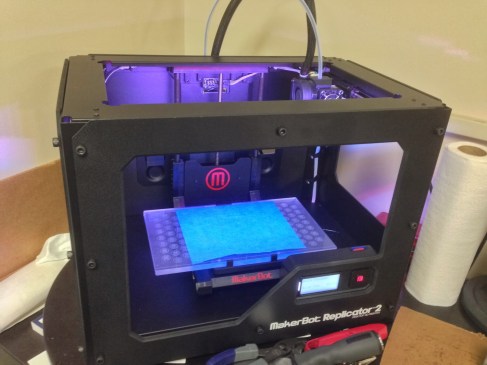
The following problem was explained by my partner Jared Vanscoder and I. A resurgence of the constructivist approaches to teaching and learning has created a demand for a solution that requires little knowledge of manufacturing processes, aids visualization through tangible representation, and speeds prototyping. Digital fabrication technologies, such as 3D printing, are garnering much attention as they afford users to simply create tangible artifacts from digital model files. This capability is enticing as an tool for teaching and learning in K-12. Given the newness of this technology, very few K-12 instructors (or even instructional technologists) are aware of how these technologies can increase engagement and instructional impact on learners.
The format of our course is designed as stand-alone instruction to be delivered in two separate formats: face to face (F2F) and online. The option of hybrid (components being delivered both F2F and online) should also be considered.
How hard is it to develop a research method that both matches your theory and created curriculum?
The activity allows learners to create order or reorganize information to construct new meaning. Learners construct knowledge, as a builder would begin building a structure. Fabrication technologies facilitate concepts of abstraction, allowing the learner to build or fabricate an actual object or model. It was not hard to match my personallearning theory to fabrication curriculum. After all, fabrication does lend itself to modeling and objects created with such a technology provide for a more meaningful approach to learning. Allowing participants to choose a “real world” scenario or object to reconstruct also fosters an active learning event, which provides further depth and richness in cognitive presence.
What was simple and what was difficult?
Creating an online instructional PD approach via problem based learning instructional design model within an e-learning context proved to be challenging. However, Jared and I are committed to being pioneers in the field of Learning Technologies and Cognitive Systems met challenges head on and worked to overcome. The overall product is very strong, with instructional goals met. However, time spent to accomplish learning goals online proves to be more intensive then a face-to-face environment. The overall learning potential I feel is greater in an online e-learning format as it forces the learner to seek solutions and not rely as heavily on an actual face to face community of learners. We suggested a reflection piece of the assessment component. Motivating teachers to complete a reflection at the end of the assessment piece may prove to be challenging. In addition, not seeing a 3D printer and only sending an STL file to post in a blog or learning management system may not be as effective as actually having access to a 3D printed product. Equitable access may prove to be a limitation within the online learning environment for fabrication PD approaches. I feel this activity challenged both Jared and I to think outside the box. As two educators and online students, we understand difficulties presented within the e-learning environment. However, the benefits of the e-Learning activity far outweigh disadvantages. Teachers are exposed to the very learning theory and instructional design methods proven to provide a rich learning experience using learning technologies that foster abstract thinking or cognitive development. Overall, I am very proud of our product. Hopefully, we can test our approach in a qualitative case study.
-
STEAM…..Teaching to Foster Creativity……
Digital technology is driving users to rethink how to create by introducing students to new styles, modes, and audiences. Students can now engage as creators, producers, contributors, users and evaluators in the social and professional environment. Tillander (2011) encourages art educators to not ignore the opportunities available, which is fostering a cultural revolution. Giving students the opportunity to contribute thoughts or reflections from research in a social context gives meaning to content. Teachers can now expose students to a variety of perspectives, which fosters critical thinking using Bloom’s Digital Taxonomy (p. 44-45). Allison (2012) encourages teachers to consider the following questions when evaluating the creative potential of existing curriculum and materials. “Is it possible for students to develop than one idea in this context? Is it possible for students to develop more than one type of idea in this context? Do students have the content knowledge necessary to successfully generate creative ideas? Do students have sufficient time and information to think through their creative ideas and communicate them” (p. 55). How do we teach creativity? As we attempt to understand issues and redesign instructional approaches, encouraging the arts across PK-16 would be an excellent start towards answering that question.
Tillander, M. (2011). Creativity, technology, art, and pedagogical practices. Art Education, 64(1), 40-46. Retrieved from http://search.proquest.com/docview/847386915?accountid=7113 Allison, A. M. (2012).
Teaching for creativity. The Science Teacher, 79(5), 54-56. Retrieved from http://search.proquest.com/docview/1023451500?accountid=7113
 Dr. Jennifer Miller-Ray